
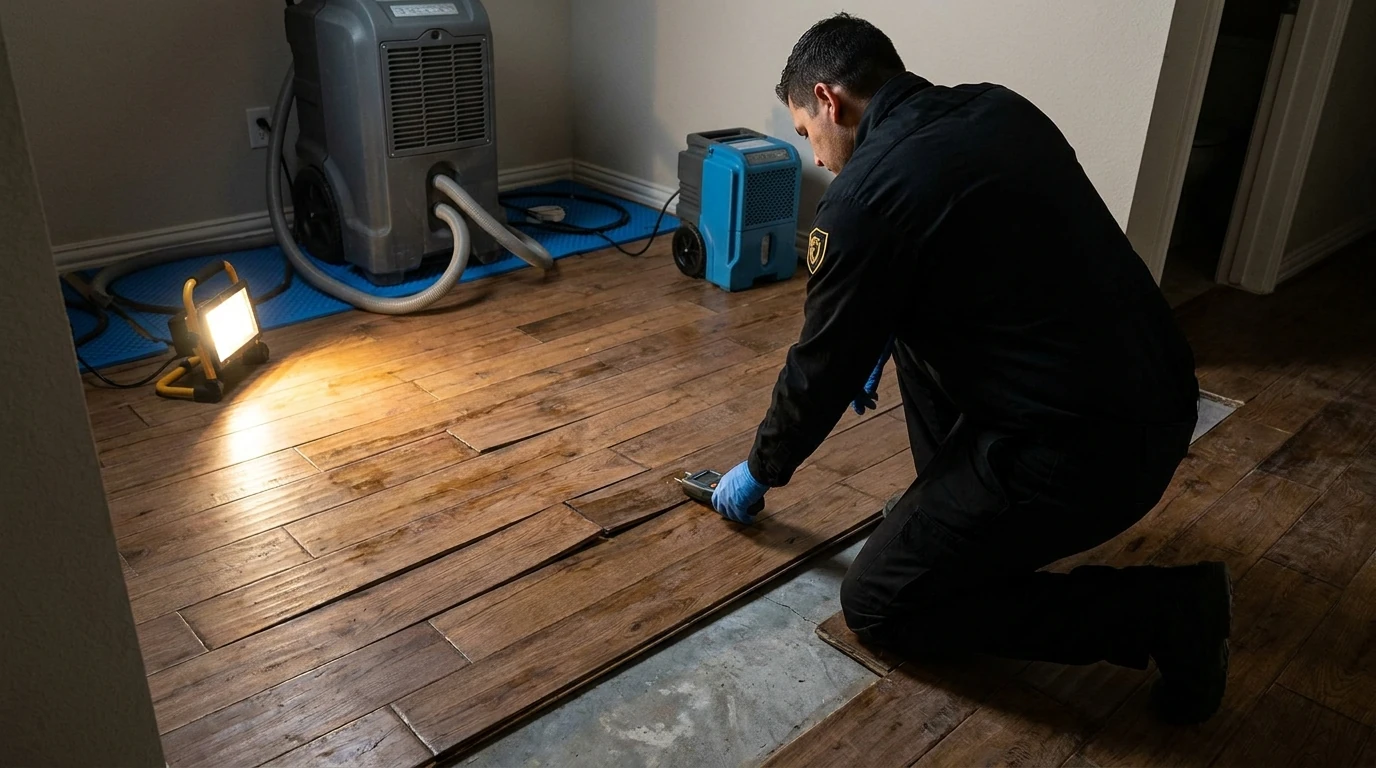
TL;DR: Whether wet hardwood can be dried in place depends on three things: how long the water sat, what type of flooring it is, and what the moisture meter reads underneath. Solid hardwood that got wet within the last 24-48 hours and hasn’t buckled can often be dried with desiccant dehumidifiers and floor drying mats. Engineered plank glued to a concrete slab, which is most DFW construction, is a different story. Water trapped under a glued-down floor can’t escape upward, so the surface can look nearly normal while the subfloor and adhesive are already failing. A surface reading alone is not enough to make that call.
You noticed the floor this morning. Maybe it’s the dishwasher line, a supply hose under the bathroom sink, or a slow leak you didn’t catch for a few days. The boards look a little off, some are raised at the edges, or there’s a soft spot near the cabinet. You’re wondering whether this is a “dry it out” situation or a “rip it up” situation. That’s the right question, and the answer depends on what the floor is actually doing and what’s happening underneath it.
What does the floor look like, and what does that tell you?
The shape of the damage tells you a lot before anyone pulls out a meter. Hardwood reacts to moisture in three distinct ways, and each one points to a different prognosis.
Cupping happens when the bottom of the board absorbs more moisture than the top. The edges rise and the center dips, giving the board a concave, trough-like shape. Cupping is the earliest sign of moisture intrusion and often the most reversible, if you catch it fast and dry the floor correctly, the boards can flatten back out as moisture equalizes. The key word is fast.
Crowning is the opposite: the center of the board rises higher than the edges. This usually happens when someone sands or dries the top of a cupped floor too aggressively before the bottom has equalized. The top shrinks while the bottom is still swollen. Crowning is harder to reverse because the wood fiber has already been stressed in both directions.
Buckling means the floor has lifted off the subfloor entirely, sometimes by an inch or more. Boards are popping at seams, tenting at the joints, or separating from the wall. Buckling is almost always a tear-out. The adhesive bond is broken, the wood has expanded beyond its tolerance, and no amount of drying will get it flat again.
If you’re seeing cupping with no separation at the seams, you may have a window. If you’re seeing buckling or significant crowning, the floor is likely a loss.
What does the moisture meter actually measure, and why surface readings lie?
A visual check tells you what the floor is doing. A moisture meter tells you what the wood is holding. These are not the same thing, and the gap between them is where most DIY assessments go wrong.
Restoration technicians use two types of meters: pin meters (which drive small probes into the wood to measure electrical resistance) and non-penetrating meters (which use radio frequency or electromagnetic fields to read moisture at depth). For hardwood floors, a properly calibrated pin meter reading at the correct wood species setting is the standard. The IICRC S500, the industry standard for water damage restoration, establishes drying goals based on moisture content (MC) relative to the equilibrium moisture content (EMC) for the region. In North Texas, equilibrium moisture content for wood typically runs 8-10%. A wet hardwood floor may read 25-40% MC or higher. The goal is to get back to within 2-4 percentage points of the regional EMC.
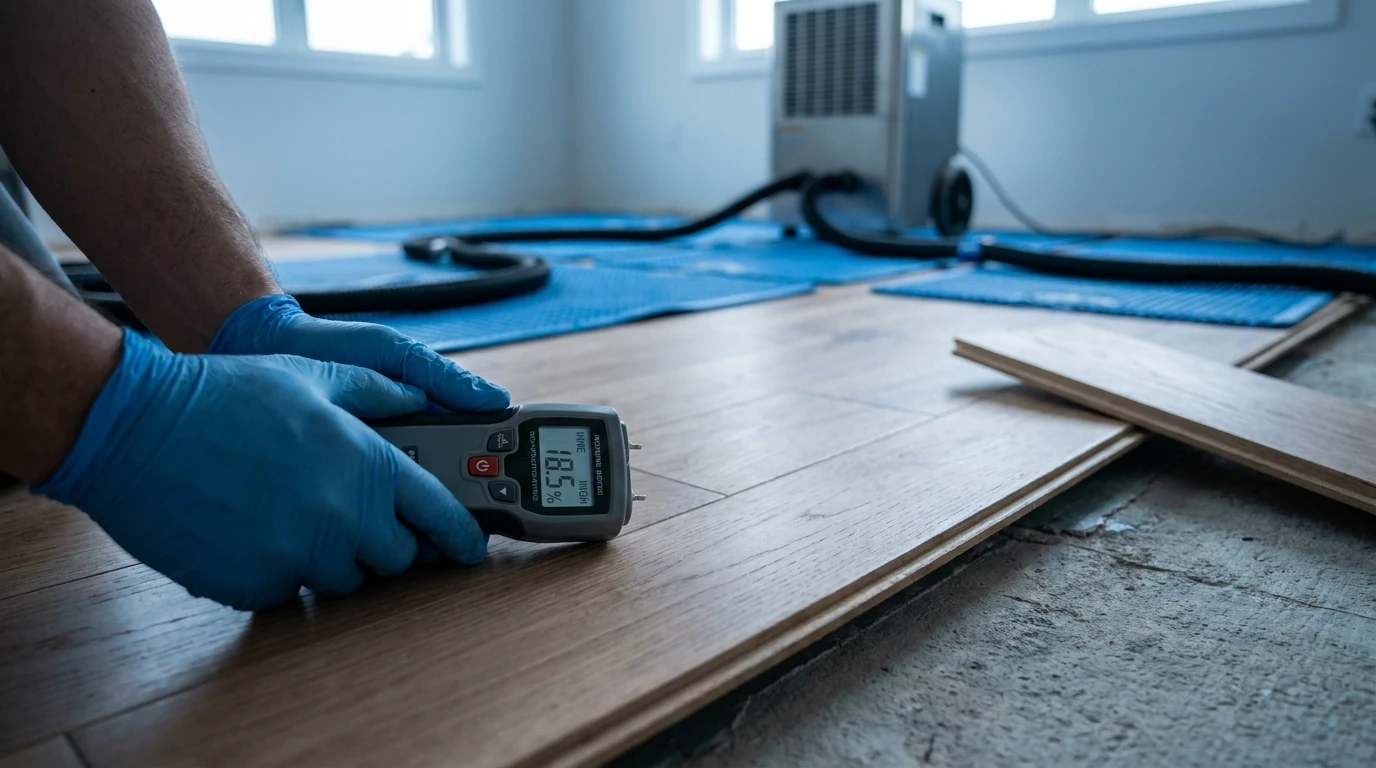
Here’s the problem with engineered plank on slab, which is the dominant floor type in most DFW construction built after the 1990s: the plank is glued directly to the concrete. Water that migrates under the floor, from a slab leak, a slow appliance drip, or water wicking under a door, has nowhere to go. The concrete holds moisture for weeks. The adhesive softens. The top surface of the engineered plank may read 12-14% MC, close to normal, while the concrete underneath reads 90%+ relative humidity and the adhesive has already failed.
A tech who only reads the surface and calls the floor dry is missing the actual problem. Proper assessment requires readings at the slab level, which means pulling a board or drilling a small test hole to get a concrete moisture reading. Thermal imaging cameras can also show temperature differentials that indicate trapped moisture under a floor that looks intact from above.
This is why a floor that looks fine on top can still be a total loss.
When does the 24-48 hour window matter?
Mold can begin to grow on wet building materials within 24-48 hours under the right conditions, and the EPA confirms this timeline in its mold cleanup guidance. In a Texas summer, with ambient temperatures in the 80s and high humidity, that window closes fast. The space under a glued-down engineered floor is dark, warm, and holds moisture, exactly the conditions mold needs.
If the water event happened more than 48 hours ago and the floor hasn’t been actively drying, mold growth under the floor is a real possibility, not a remote one. This changes the project. It’s no longer just a drying job, it becomes a mold remediation job, which requires containment, HEPA filtration, and proper disposal of contaminated materials. Pulling up a moldy floor without containment spreads spores through the HVAC system and into the rest of the house.
If there’s any question about timing or whether mold is present, treat it as a mold situation until testing says otherwise. For more on identifying hidden mold, see 7 Signs You Have Hidden Mold (and What To Do Next).
What actually happens during professional floor drying?
When the moisture readings and the visual assessment support a dry-in-place approach, the process looks like this:
- Extract standing water first. Any free water on the surface comes up with a wet-vac or extraction wand before drying equipment goes down.
- Deploy desiccant dehumidifiers and floor drying mats. Standard LGR (low-grain refrigerant) dehumidifiers pull moisture from the air. Floor drying mats, rigid panels placed directly on the hardwood and connected to a desiccant dehumidifier, draw moisture up through the wood from below. This is the equipment that makes in-place drying viable; box fans do not do the same job.
- Monitor daily. A tech takes moisture readings at the same points every day and logs them. The floor is not “dry” until readings stabilize at or near the regional EMC for two consecutive days.
- Assess for flatness. Once dry, the floor is re-evaluated. Minor cupping that has resolved may require sanding and refinishing. Crowning or remaining distortion usually means replacement.
The full water damage restoration process, from extraction through monitoring to final documentation, typically takes 3-5 days for a contained floor event, longer if the slab is involved.
For the flooring itself and any furniture or contents that absorbed moisture, contents restoration can address wood furniture, cabinetry, and personal property separately from the structural drying scope.
What should you do right now?
Stop the source of water first, if you haven’t already. The burst pipe checklist covers the immediate steps for supply-line failures. Then get the floor assessed by someone with the right meters, not a visual inspection, not a surface reading only.
The decision to dry in place versus tear out is not one to make based on how the floor looks. It’s made based on moisture content at the subfloor level, the type of flooring, how long the water has been present, and whether mold conditions have been met. Getting that assessment wrong in either direction costs money: unnecessary tear-out is expensive, but missed moisture under a slab leads to mold, structural damage, and a much larger project later.
If you’re in the DFW area and need a moisture assessment on a wet hardwood floor, Reign Restoration carries IICRC WRT certification and responds 24/7. Call (214) 304-0621 to schedule an assessment.
About Reign Restoration
Reign Restoration is an IICRC Certified Firm serving the Dallas-Fort Worth area, including Royse City, Rockwall, Plano, McKinney, and surrounding communities (license MRC2276). Founded and locally owned, their certified crews handle water damage restoration, mold remediation, fire and smoke damage, storm damage, contents restoration, and general contracting. They operate 24/7 for emergency response across the region.
Video Transcript
You woke up to a wet floor this morning. Now you’re asking the most important question: can this be dried out, or does it have to come up? The shape of the damage tells you a lot. Cupping — where board edges rise and the center dips — is the earliest sign. Caught fast, it’s often reversible. Buckling is different. Boards lifting off the subfloor, tenting at seams, separating from walls — that floor is almost always a tear-out. A visual check only tells half the story. A moisture meter tells you what the wood is actually holding — and these two things are not always the same. Here’s the problem with glued-down engineered plank — which is most DFW construction. Water trapped under the floor has nowhere to escape upward. The surface can read almost normal while the concrete underneath is saturated and the adhesive is already failing. Surface readings alone will miss this. Mold can start growing under wet materials within 24 to 48 hours. In a Texas summer, that window closes fast — especially under a dark, sealed floor. Proper drying means getting below the surface — checking slab moisture, using desiccant dehumidifiers, and running floor-drying mats over the affected area. Not sure what you’re dealing with? Get a proper assessment before guessing. Call Reign Restoration at (214) 304-0621 for a free estimate.