
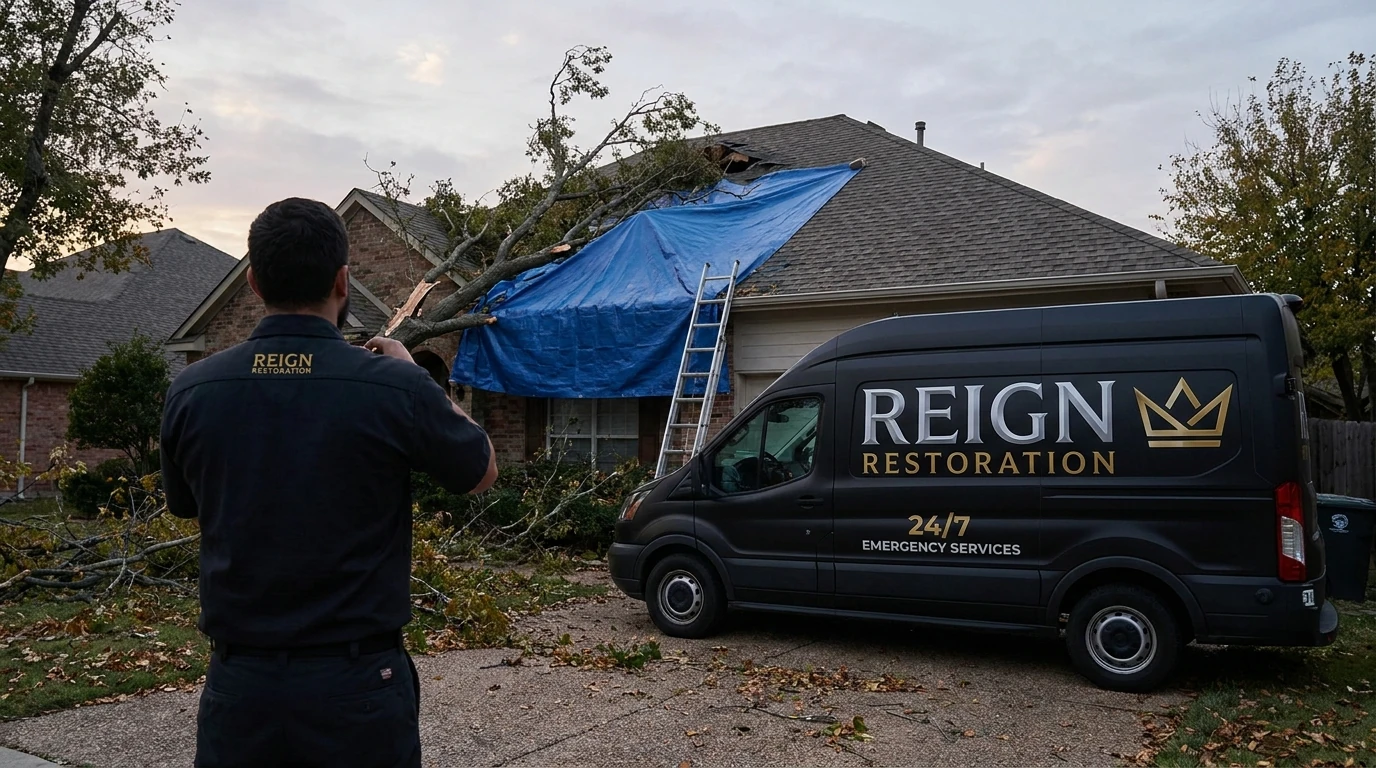
TL;DR: If a tree falls on your house, check everyone is safe and away from downed power lines first, then call 911 only if someone is hurt or a line is sparking. After that, call a storm damage restoration company to tarp the roof and stop water intrusion, then call your homeowners insurance carrier. Tree removal itself is usually a separate call to an arborist or tree service, since most restoration companies handle the structure and water damage, not the tree.
If you just heard the crash, walked outside, and found a limb or a whole tree sitting on your roof in Royse City, you are not alone in not knowing what order to make calls in. The next 30 minutes matter more than the next 30 days: getting people clear of the hazard, stopping water from pouring into the attic, and documenting the damage before anything gets moved.
What do I do in the first 10 minutes after a tree falls on my house?
Get everyone out from under the damaged section and away from any power line the tree is touching, even if it looks dead. A downed line can still be energized, and a strained roof structure can shift further without warning.
If anyone is injured, trapped, or a line is sparking or smoking, call 911 immediately. If a line is down but no one is hurt, call Oncor (or your local utility) to report it before anyone approaches the tree. Do not attempt to cut, move, or climb onto the tree yourself, and keep kids and pets inside another part of the house until a professional has looked at the structure.
Once the scene is safe, take photos and a short video of the tree, the point of impact, and any interior damage, before anything is moved or covered. This record is what your insurance adjuster will ask for first.
Who do I call first after the scene is safe?
After 911 or the utility company (if either applies), call a storm damage restoration company to get a tarp on the roof and stop water from spreading into the attic and ceilings. Reign Restoration handles that structural stabilization, emergency tarping, and any interior water damage in Royse City and the surrounding Rockwall and Hunt County area, 24 hours a day at (214) 304-0621.
That’s a different call than tree removal. Most restoration crews are not equipped or licensed to fell or remove a full tree from a roof, so a certified arborist or tree service typically handles getting the tree itself off the house, often working alongside the restoration crew so the roof gets tarped the moment the weight is clear. If the tree is small enough that it’s already off the roof deck, the restoration crew can usually move straight to tarping and assessment.
How does emergency tarping and board-up actually work?
Emergency tarping is a temporary, heavy-duty cover installed over the damaged roof section to stop active water intrusion until permanent repairs can be scheduled. It is not a repair, it’s a stopgap that buys time without the attic and ceilings taking on more water.
A crew will clear loose debris from the damaged area, measure the opening, and stretch a reinforced tarp over the hole, securing it with furring strips screwed into the roof deck rather than just nails through the tarp, which tend to pull loose in Texas wind. Broken windows or exterior walls get boarded up with plywood the same visit. If the tree also tore gutters, soffit, or siding, that gets photographed and noted for the insurance scope, even if it’s not covered the same day.
A properly installed tarp can usually hold through several weeks of North Texas weather, but it’s meant to last until the permanent roofing repair is scheduled, not indefinitely.
Will homeowners insurance cover a tree that fell on my house?
Most standard homeowners policies cover sudden damage from a falling tree, including the cost to remove the part of the tree that’s actually on the structure, even if the tree itself came from a neighbor’s yard. Coverage for removing the rest of the tree from your yard, when it didn’t hit anything, is usually limited or excluded.
What the adjuster will want to see is the timeline and the cause: a storm or high wind that brought the tree down is a covered peril under most policies, while a tree that was already dead, leaning, or reported as a hazard beforehand can complicate the claim. This is exactly why the photos from step one matter, and why getting a written scope of the tarping and interior damage from the restoration crew helps the claim move faster. The Texas Department of Insurance has a plain-language breakdown of what storm-related claims typically cover and how to file one. Our own breakdown on who to call for storm damage in Royse City covers the claim-filing order in more detail if you want it.
What happens when the crew gets to the house?
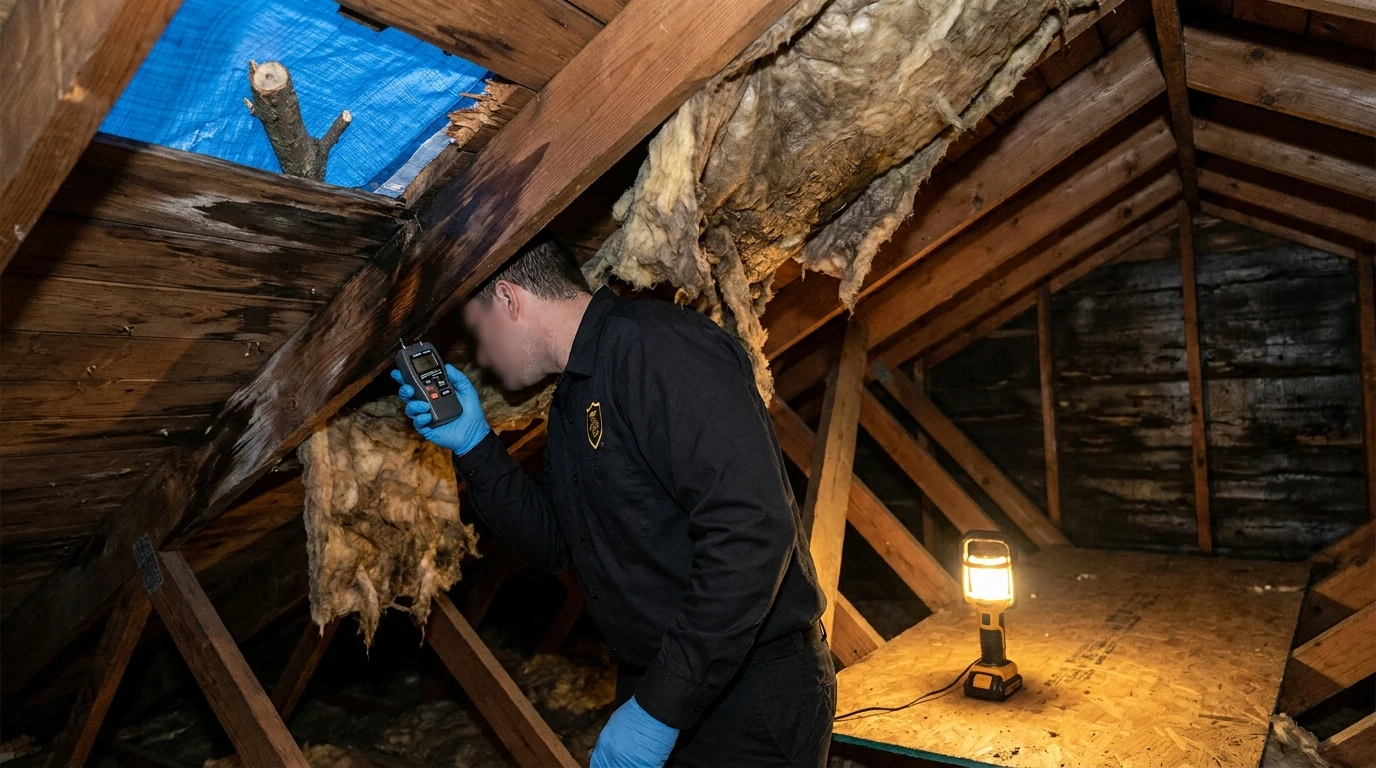
The crew documents the damage, tarps or boards the opening, and checks for water that may have already reached the attic insulation, ceiling drywall, or walls before stabilizing the structure. If the tree punched through the roof deck, water intrusion is almost always already underway by the time anyone calls, even in dry weather, because attic insulation holds moisture long after the rain stops.
Moisture meters get used on the ceiling and attic framing near the point of impact to see how far the water traveled. Wet insulation typically has to come out, and if drywall tested wet, it gets dried in place or removed and that falls under water damage restoration rather than the storm repair itself. Both get documented in one scope so the adjuster sees the full picture instead of two separate claims.
From there, the permanent roof repair gets scheduled, materials get ordered, and the tarp holds until that crew is on-site. If you’re not sure whether what you’re looking at needs a tarp tonight or can wait until morning, a quick call walks through it: request a storm damage assessment and describe what you’re seeing.
A fallen tree on the roof is a structural emergency and a water damage risk at the same time, which is why the order of calls matters: safety first, utility company if there’s a downed line, then a restoration crew to stop the water, then insurance. Getting that sequence right is most of what keeps a bad night from turning into a bad month.
About Reign Restoration
Reign Restoration is an IICRC Certified Firm (license MRC2276) serving Royse City, TX and the surrounding Rockwall, Fate, Rowlett, and Wylie area, available 24/7 at (214) 304-0621. The company’s technicians hold IICRC Water Restoration (WRT) and Fire & Smoke (FSRT) credentials and handle storm damage stabilization, roofing, water damage restoration, and reconstruction for homes across North Texas.