
TL;DR: To file a water damage insurance claim in Texas, report the loss to your carrier immediately, photograph everything before cleanup starts, and begin mitigation right away (your policy requires it, it does not void your claim). Texas law under Insurance Code Chapter 542 sets deadlines for the insurer to acknowledge, investigate, and pay. Most straightforward claims resolve in two to six weeks; large or disputed losses take longer, which is when a public adjuster may be worth the cost.
If you’ve already got a mitigation crew pulling wet carpet out of your living room and a claim number from your insurer, but nobody’s told you what happens next, that gap is where most homeowners lose money on an otherwise valid claim. The process itself isn’t complicated, but it is sequence-dependent: do the documentation step out of order and you hand the adjuster a reason to undervalue the loss. This post covers the process: what to document, what your policy actually requires of you, what the adjuster is scoring, and how long it should take in Texas. For whether your specific loss is covered at all, see our plain-English coverage guide first.
What do I need to document before the adjuster arrives?
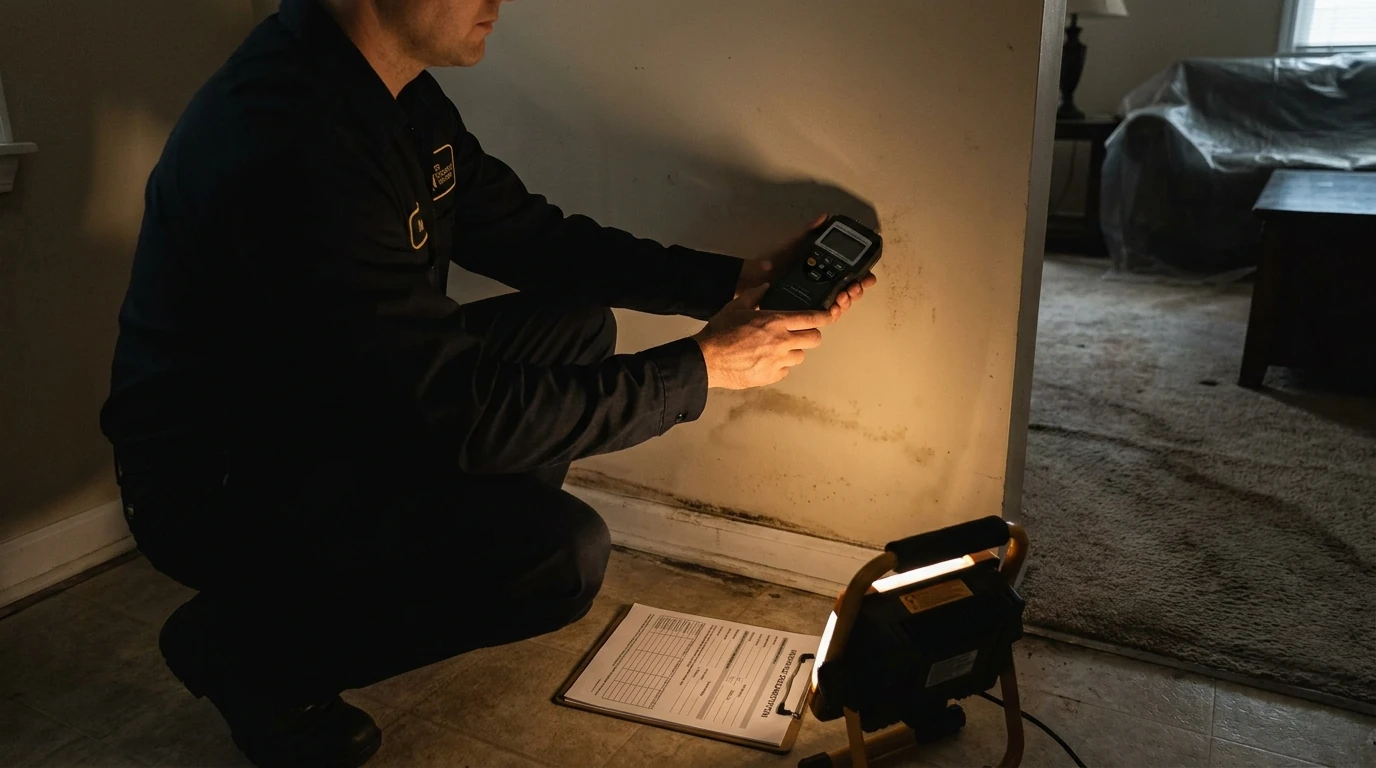
Document the source, the spread, and the contents before anyone touches or removes anything, if it’s safe to do so. Photos and video taken in the first hour are worth more to your claim than anything you say on the phone later.
At minimum, capture: a wide shot of every affected room before extraction starts, a close-up of the water source (the burst supply line, the failed water heater, the roof penetration), moisture meter readings if your restoration crew has already arrived, and a room-by-room inventory of damaged contents with photos of each item. If you have receipts, warranty cards, or even old photos showing furniture or electronics in place, pull them. Insurers pay actual cash value or replacement cost depending on your policy language, and the burden of proving what was there and what it was worth sits with you, not the adjuster.
Date-stamp everything if your phone doesn’t already, and keep a simple written timeline: when you discovered the water, when you shut off the source, when you called your restoration company, when you called the insurer. Adjusters read that timeline as a proxy for how quickly you acted, which matters for the next section.
Does calling a restoration company before the adjuster arrives void my claim?
No. Most Texas homeowners and commercial policies contain a mitigation clause that obligates you to stop ongoing damage as soon as it’s discovered, and calling a restoration company to extract water and start drying satisfies that duty rather than undermining it.
The clause exists because insurers don’t want a small loss to become a mold claim or a structural claim because nobody pulled standing water for a week waiting on an appointment. Waiting for the adjuster before you extract water is the version that actually hurts your claim, because it reads as failure to mitigate, and some carriers will deny the portion of damage that occurred after the point they believe you should have acted.
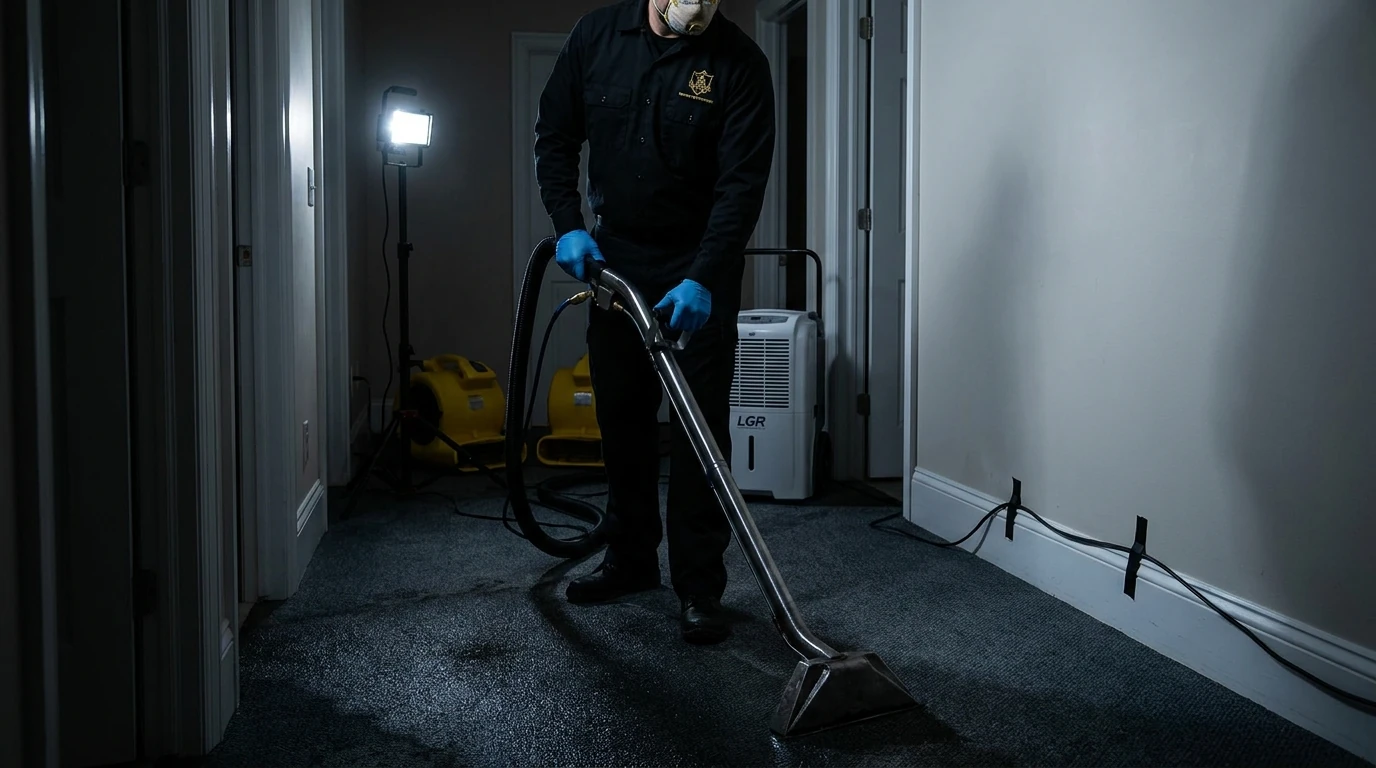
What matters is documenting the mitigation step, not avoiding it. A restoration crew working to the IICRC S500 standard will log moisture readings, photograph pre-mitigation conditions, and produce a written scope before drying begins, which becomes part of your claim file. Reign Restoration’s technicians are IICRC WRT-trained specifically to generate that documentation alongside the extraction and drying work, which is the paper trail an adjuster expects to see. That’s the difference between mitigation that helps your claim and demolition that happened before anyone wrote down what was there.
What does the adjuster actually look for during inspection?
The adjuster is scoring three things: the cause of loss, the category of water, and whether the damage matches the documented timeline. Get these three wrong on your own account and the claim gets delayed, not denied outright, while the carrier investigates.
Cause of loss separates sudden and accidental events (a burst pipe, a failed washing machine hose, wind-driven rain through a storm-damaged roof) from gradual issues (a slow plumbing leak behind a wall over months, deferred maintenance). The first category is typically covered; the second usually isn’t, which your coverage guide covers in more depth.
Category of water matters for scope and cost. Category 1 is clean water from a supply line. Category 2 is gray water, from a dishwasher or washing machine discharge, for example. Category 3, also called black water, comes from sewage backup or flooding and requires more extensive removal of porous materials. The adjuster will expect your restoration company’s moisture logs and category classification to match what they see on-site, which is another reason the documentation from the mitigation step matters.
Finally, the adjuster walks the property comparing what they see to your timeline and photos. Gaps here (drywall already removed with no before photos, contents already discarded) are the single biggest reason claims get partially denied.
How long does a water damage insurance claim take in Texas?
Texas law gives insurers specific deadlines, and most straightforward claims settle in two to six weeks once the paperwork is complete. Large losses, contested cause-of-loss determinations, or claims requiring engineering review take longer.
Under the Texas Insurance Code’s prompt payment provisions, a carrier must acknowledge receipt of your claim within 15 days and either accept, deny, or request additional information within 15 business days of receiving everything it needs to evaluate the loss (extendable once, in writing, for up to an additional 45 days in complex cases). Once a claim is accepted, payment is due within 5 business days. The Texas Department of Insurance publishes these deadlines and the consumer complaint process if a carrier misses them.
In practice, the clock doesn’t really start until your file is complete: contractor estimate, moisture documentation, contents inventory, and proof of loss form all submitted. The fastest way to compress the timeline is to hand the adjuster a complete file on the first visit instead of in pieces over several weeks.
When is hiring a public adjuster worth it?
A public adjuster earns its fee on large, complex, or disputed losses, not on a straightforward single-room claim with clear documentation. Public adjusters typically charge 5 to 15 percent of the settlement, which only makes sense when the gap between the insurer’s initial offer and the actual repair cost is wide.
That gap tends to open on losses involving multiple floors, extensive contents, hidden damage discovered during demolition, or a cause-of-loss dispute where the carrier is leaning toward denial. If your claim is a single bathroom with a failed supply line and solid before/after documentation, a public adjuster’s cut is rarely worth it. If you’re looking at a whole first floor, a finished basement, or storm damage affecting both the roof and interior, it’s worth a consultation before you sign anything with the insurer.
Either way, the documentation work described above is what makes a public adjuster’s job easier if you decide to hire one, and it’s what makes the adjuster’s first offer more accurate if you don’t.
A clean claim file starts at the mitigation step, which is also the step most homeowners handle worst because they’re focused on the water, not the paperwork. If you’re dealing with an active water loss anywhere from Royse City to Rockwall, Rowlett, or the greater Dallas area, our water damage restoration crews document the loss to IICRC standards as they dry it, and our contents restoration team handles the inventory and pack-out side your adjuster will ask for. For wind- or hail-driven losses, our storm damage restoration team coordinates the roof and interior scope together so the claim reads as one event, not two.
About Reign Restoration
Reign Restoration is an IICRC Certified Firm serving Royse City, Rockwall, and the greater Dallas-Fort Worth area, licensed under Texas Mold Remediation Contractor registration MRC2276. The company’s technicians hold IICRC Water Damage Restoration (WRT) and other IICRC credentials and operate on a 24/7 emergency basis, with crews that document moisture readings and scope throughout the mitigation process to support the insurance claim that follows.
Call Reign Restoration at (214) 304-0621 to schedule a water damage assessment and start the documentation your claim will need.