
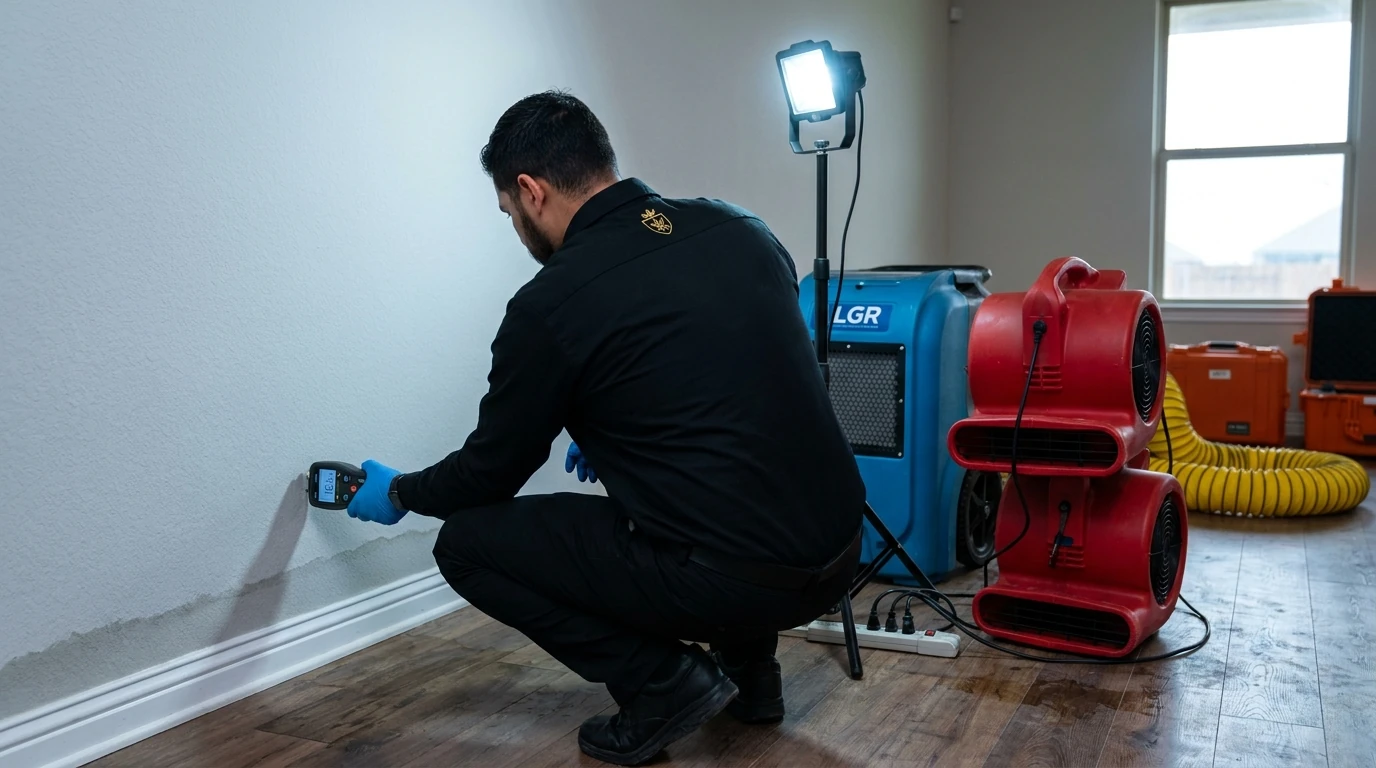
TL;DR: Water damage restoration in Texas typically costs $1,500 to $12,000 for a residential loss, with most homeowners paying between $3,000 and $7,500. The biggest cost drivers are the category of water involved (clean, gray, or black), the square footage affected, and how long the water sat before extraction began. Costs rise sharply when structural materials like drywall, subfloor, or cabinetry need replacement after drying.
If you just discovered water damage in your Royse City home, whether from a burst pipe, a failed water heater, or a roof leak after a North Texas storm, the first question most homeowners ask is: what is this going to cost me? The answer depends on a handful of specific factors, and understanding them helps you evaluate any estimate you receive and know what your insurance adjuster is looking at.
How Much Does Water Damage Restoration Cost in Texas?
In Texas, water damage restoration typically costs $1,500 to $12,000 for a residential job, with the average falling around $3,500 to $5,500 for a single-room loss involving clean or gray water. Larger losses, a slab leak that soaked multiple rooms, or a Category 3 sewage backup, can run $10,000 to $25,000 or more when structural replacement is included.
Here is a realistic breakdown by scenario:
| Scenario | Typical Cost Range |
|---|---|
| Single room, clean water (Cat 1), drying only | $1,200 - $3,500 |
| Single room, gray water (Cat 2), drying + antimicrobial | $2,500 - $5,500 |
| Multi-room loss, clean or gray water | $4,500 - $9,000 |
| Sewage backup or black water (Cat 3), single area | $5,000 - $12,000 |
| Slab leak affecting multiple rooms + subfloor | $7,500 - $18,000 |
| Whole-home flooding, storm or appliance failure | $12,000 - $30,000+ |
These are industry-typical ranges for the North Texas market. Every loss is different, and Reign Restoration provides a written scope of work before any work begins, so you know exactly what you are paying for.
What Factors Drive the Cost Up or Down?
Several variables move the final number significantly. Understanding them helps you ask the right questions when you get an estimate.
Water category. The IICRC S500 standard classifies water losses into three categories. Category 1 is clean water from a supply line or appliance, the least expensive to remediate. Category 2 is gray water (washing machine overflow, dishwasher leak) and carries biological load that requires antimicrobial treatment. Category 3 is black water, sewage, floodwater, or any water that has been standing long enough to become grossly contaminated. Cat 3 jobs require full PPE, more aggressive remediation protocols, and often more material removal, which drives costs higher.
Water class and affected materials. The IICRC also classifies losses by how deeply water has penetrated. Class 1 means minimal absorption; Class 4 means water has soaked into hardwood, concrete, or plaster and requires specialty drying. A Class 4 loss in a Royse City home with engineered hardwood floors costs significantly more to dry than a Class 1 carpet-and-pad loss.
Square footage affected. Equipment costs (air movers, LGR dehumidifiers, desiccant units) scale with the area being dried. A 200-square-foot bathroom loss requires far less equipment than a 1,500-square-foot main floor.
Response time. Water that sits for 24 to 48 hours begins wicking into drywall, insulation, and subfloor. After 48 to 72 hours, mold colonization becomes a real risk. Fast extraction limits secondary damage and keeps costs lower. If you are dealing with an active loss right now, the EPA’s guidance on mold and moisture underscores why the 24-to-48-hour window matters.
Structural replacement vs. drying only. Mitigation (extraction, drying, antimicrobial treatment) is separate from reconstruction. If drywall, insulation, cabinetry, or flooring must be removed and replaced, those costs are added on top of the mitigation scope. A drying-only job at $3,500 can become a $9,000 job once the rebuild is included.
Code upgrades. In some cases, opening walls for drying exposes wiring or plumbing that must be brought up to current code before the wall closes. This is not the restoration company’s call, it is the building inspector’s, but it is worth knowing it can add cost.
Does Homeowners Insurance Cover Water Damage Restoration in Texas?
Most standard Texas homeowners policies cover sudden, accidental water damage, a burst pipe, a washing machine supply line failure, or an ice-maker line that let go overnight. They typically do not cover gradual leaks (a slow drip under the sink that went unnoticed for months), flooding from outside the home (that requires a separate NFIP or private flood policy), or losses caused by deferred maintenance.
For a deeper look at what policies actually pay out, see our guide: Does Homeowners Insurance Cover Water Damage? A Plain-English Guide.
Here is what matters for your claim:
- Document everything before cleanup begins. Photos and video of standing water, affected materials, and equipment readings protect your claim. A professional restoration company should provide moisture mapping and drying logs that your adjuster can review.
- Your deductible applies. Texas homeowners policies typically carry deductibles from $1,000 to $5,000 or more. If the loss is $4,000 and your deductible is $2,500, you pay $2,500 out of pocket.
- The adjuster works from a scope. The restoration company’s written scope of work, line items, quantities, and unit costs, is what the adjuster reviews. A vague estimate creates disputes; a detailed scope protects you.
- Mold discovered during drying may or may not be covered. Some policies include limited mold coverage; others exclude it entirely. If mold is found, document it immediately and notify your insurer before remediation begins.
Reign Restoration works directly with insurance carriers and provides the documentation adjusters need, moisture readings, drying logs, photo documentation, and a line-item scope, so the claims process moves without unnecessary delays.
What Does the Water Damage Restoration Process Actually Look Like?
Knowing the steps helps you understand what you are paying for and what a legitimate restoration company should be doing.
- Emergency contact and assessment. A technician arrives, identifies the water source, and categorizes the loss. If water is still flowing, the source is stopped first.
- Water extraction. Truck-mounted or portable extractors remove standing water. This is the fastest step, extraction of a single room typically takes 30 to 90 minutes.
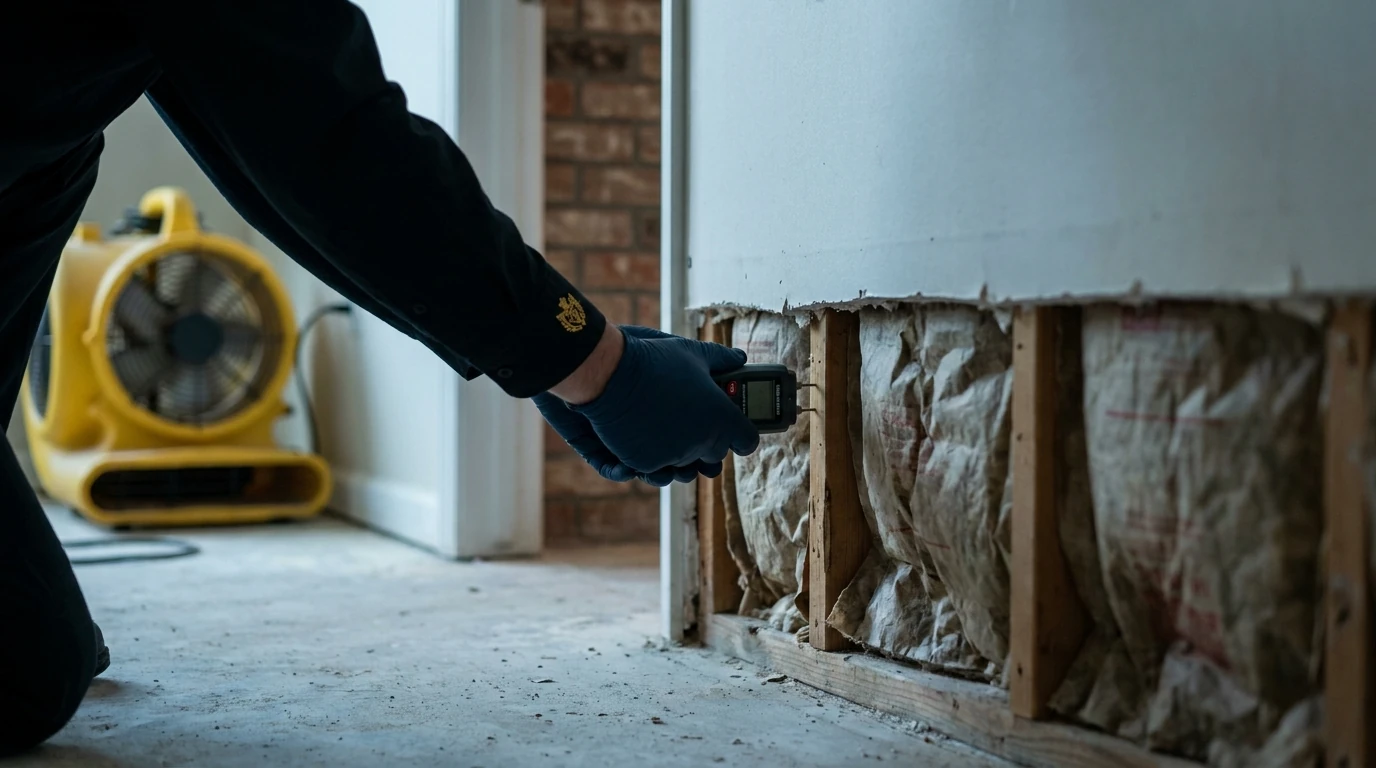
- Moisture mapping. Technicians use thermal imaging cameras and pin or pinless moisture meters to find where water has traveled inside walls, under floors, and into cavities. This determines the drying zone.
- Structural drying. Air movers and LGR (low-grain refrigerant) dehumidifiers are placed to create an aggressive drying environment. The IICRC S500 standard sets the drying goals, typically returning affected materials to within 4 percentage points of the moisture content of unaffected materials in the same structure.
- Antimicrobial treatment. For Category 2 or Category 3 losses, EPA-registered antimicrobial agents are applied to affected surfaces.
- Monitoring. A technician returns daily (or every other day) to record moisture readings and adjust equipment placement. Most residential drying jobs reach goal in 3 to 5 days.
- Demolition if needed. Drywall, insulation, or flooring that cannot be dried in place is removed. This is called “flood cuts” for drywall, typically 12 to 24 inches above the waterline.
- Final documentation. Drying logs, before-and-after moisture readings, and photo documentation are compiled for the insurance claim and for your records.
- Reconstruction. Once the structure is dry and the adjuster has approved the scope, reconstruction begins, drywall, paint, flooring, cabinetry, whatever was removed.
For a step-by-step guide to what you should do in the first hours after a loss, see: What To Do in the First 24 Hours After Water Damage.
What Should You Do Right Now?
If you have active water damage in Royse City or anywhere in the surrounding area, Rockwall, Fate, Rowlett, Wylie, or the broader Dallas metro, the clock matters. Every hour water sits in a structure increases the drying time, the cost, and the mold risk.
Call Reign Restoration at (214) 304-0621. They are available 24/7, IICRC-certified (WRT and AMRT), and licensed in Texas (MRC2276). A technician will assess the loss, walk you through the scope, and handle the insurance documentation from the first call forward.
If you are still comparing your options, the Best Water Damage Restoration Companies in Royse City post breaks down what to look for in a local restoration firm.
About Reign Restoration
Reign Restoration is an IICRC Certified Firm serving Royse City, TX and the surrounding North Texas area (license MRC2276). Their team holds IICRC certifications in Water Damage Restoration (WRT), Mold Remediation (AMRT), and Fire and Smoke Restoration (FSRT). Services include water damage restoration, fire damage restoration, mold remediation, storm damage restoration, general contracting, and contents restoration. Reign Restoration is locally owned, licensed and insured, and available 24/7 for emergency response.
Video Transcript
Just found water damage in your Texas home? The first question everyone asks is: how much is this going to cost me? Let’s break it down. For most Texas homeowners, water damage restoration runs between three thousand and seventy-five hundred dollars. Smaller jobs start around fifteen hundred; major losses can exceed twenty-five thousand. The single biggest cost factor is the type of water involved. Clean water from a burst pipe costs least. Gray water from a washing machine costs more. Black water — sewage or floodwater — costs the most. Square footage matters too. Drying a two-hundred-square-foot bathroom needs far less equipment than drying your entire main floor. Speed is critical. Water soaks into drywall and subfloor within twenty-four hours. After forty-eight hours, mold risk becomes very real — and mold adds significant cost. A restoration pro will use a moisture meter to map exactly where water traveled — giving your insurance adjuster the documentation they need to approve your claim. Drying alone might cost thirty-five hundred dollars. But if drywall, flooring, or cabinets need replacing, that same job can climb to nine thousand or more. Most Texas homeowners insurance covers sudden, accidental water damage — like a burst pipe. It typically won’t cover slow leaks or outside flooding without a separate flood policy. Don’t wait — water damage gets more expensive every hour. Call Reign Restoration at two-one-four, three-oh-four, oh-six-two-one for a free estimate today.