
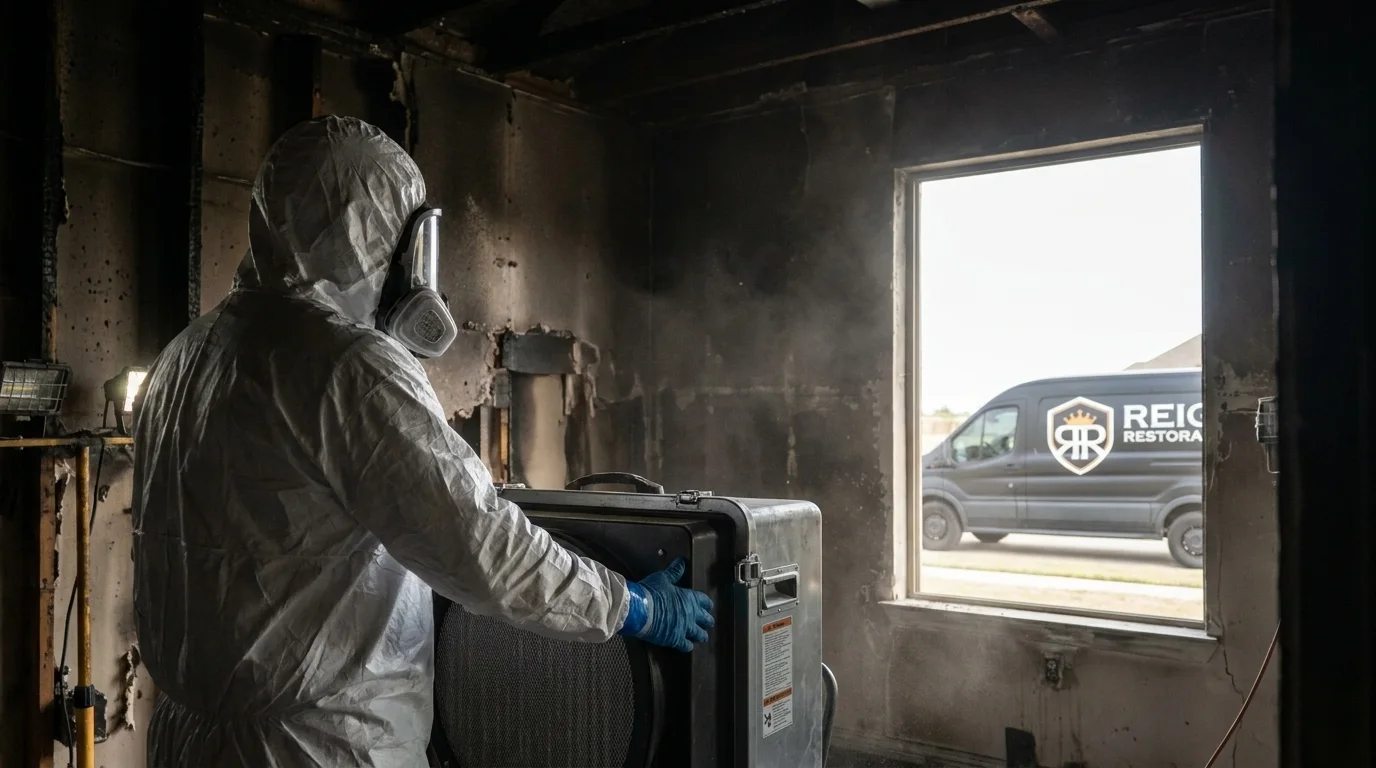
24/7 Emergency Fire Damage Restoration in Dallas
24/7 emergency fire damage restoration in Dallas, TX. IICRC-certified, insurance billing accepted. Call (214) 304-0621.
Our IICRC-certified technicians are dispatched from our Royse City, TX headquarters and are typically on-site in Dallas within 60 minutes of your call.
Fire damage emergency in Dallas? We answer 24/7. Call now and our crew heads out to secure the property and start the recovery.
When a kitchen fire tears through a Lakewood Tudor or a grease fire escapes a Deep Ellum restaurant kitchen, the damage compounds fast, smoke penetrates plaster walls within minutes, soot begins etching surfaces within hours, and the acrid smell of burned materials settles into every cavity of the structure. Dallas fires carry a specific character: the city’s dry, hot summers mean wood framing and older insulation are often desiccated before a fire even starts, which accelerates burn spread and leaves behind a denser, oilier smoke residue than you’d see in more humid climates. Reign Restoration responds 24/7 and holds IICRC FSRT (Fire & Smoke Restoration Technician) certification, so the crew arriving at your door is trained specifically for what fire leaves behind, not just what it burns.
Why Dallas Properties See Distinct Fire Damage Patterns
Dallas sits on two very different geological and architectural worlds divided by the Austin Chalk escarpment. East of the escarpment, neighborhoods like Lakewood, the M Streets (Greenland Hills), and Casa Linda, the housing stock runs heavily toward 1920s–1940s construction: pier-and-beam foundations, original cast-iron drain lines, plaster-over-lath walls, and old-growth pine framing that is both extremely dry and extremely dense. When these homes burn, the plaster and lathe create layered voids that trap smoke and soot in ways modern drywall simply doesn’t. Soot migrates into the original hardwood subfloor gaps, into the pier-and-beam crawl space, and into cast-iron drain vents that run through interior walls.
West of the escarpment, Oak Cliff rolls on clay-heavy soil with a mix of 1940s bungalows and mid-century construction. Lake Highlands, by contrast, runs to 1960s slab-on-grade ranch homes where fire can travel quickly through open attic trusses. Uptown’s high-rise condominiums introduce a different challenge entirely: shared HVAC systems can carry smoke odor to units floors away from the origin, and HOA rules often govern what restoration work requires board approval before it begins.
Dallas’s climate adds pressure: summer temperatures regularly exceed 100°F, which accelerates the off-gassing of smoke residue into building materials. Acting quickly, ideally within the first 24 to 48 hours, limits how deeply those compounds bond to surfaces.
Our Fire Damage Restoration Process in Dallas
Every job starts with a structured assessment before any cleaning begins. The team documents the fire origin point, maps the smoke migration path through the structure, and identifies which materials are restorable versus which require removal. This documentation goes directly to your insurance adjuster in a format carriers recognize, which shortens the back-and-forth on scope approvals.
Demolition and debris removal come next, charred framing, compromised insulation, and unsalvageable drywall or plaster are pulled and disposed of properly. For the older homes in the 75214 ZIP code corridor and surrounding East Dallas neighborhoods, this phase often reveals hidden smoke damage inside wall cavities that a surface inspection would miss.
Odor elimination is where fire restoration diverges most sharply from general cleanup. Thermal fogging, hydroxyl generation, and ozone treatment are matched to the specific smoke type, protein smoke from a kitchen fire behaves differently than synthetic smoke from burning plastics or cellulose smoke from structural wood. The wrong treatment can drive odor deeper rather than neutralize it. After structural surfaces are cleaned and treated, content cleaning and pack-out services handle salvageable furniture, clothing, and personal items.
Final reconstruction, framing, insulation, drywall, painting, and finish work, closes the job so you’re not left coordinating a separate general contractor.
Reaching Dallas from Royse City
Reign Restoration’s base in Royse City puts the crew roughly 30 miles east of central Dallas via I-30. That corridor runs directly into East Dallas neighborhoods, Lake Highlands, Casa Linda, and the M Streets are all reachable before the interstate even reaches downtown. For calls originating in Oak Cliff or the Bishop Arts District, the route continues west across the Margaret Hunt Hill Bridge or south on I-35E. Because Reign operates 24/7, dispatch happens immediately on contact, no waiting for a business-hours callback when smoke is still settling into your walls at 2 a.m.
Dallas Insurance and HOA Coordination
Texas homeowners’ policies vary significantly in how they handle smoke and soot damage versus structural fire damage, and Dallas adjusters see a high volume of fire claims, particularly after dry-season events. Reign documents losses with photo evidence, moisture and soot mapping, and itemized scope reports formatted for carrier review. For properties in Uptown high-rises or Preston Hollow HOA communities, restoration work often requires permit pulls and HOA approval before structural repairs begin. The team coordinates that paperwork rather than leaving it on the homeowner’s plate during an already stressful period.
Local Note
In the older pier-and-beam homes common to Lakewood and the M Streets, smoke doesn’t just travel through rooms, it drops into the crawl space beneath the floor system. Cast-iron drain vents and the open joist bays act as chimneys in reverse, pulling soot-laden air downward and depositing residue on the underside of subfloor sheathing. A restoration crew that only cleans above the floor will leave behind a persistent odor source that no amount of surface treatment will fully resolve. Reign’s fire assessments include a crawl space inspection on pier-and-beam structures specifically because of this pattern.
If your home or property in Dallas has been through a fire, whether a contained kitchen incident or a structural loss, call Reign Restoration at (214) 304-0621. IICRC-certified fire and smoke restoration technicians are available around the clock to assess the damage, stop the spread, and walk you through every step from debris removal to final reconstruction.
Serving Dallas from our Royse City headquarters — ★ 5.0 · 27 Google reviews
“I can’t say enough good things about Reign Restoration. Every project they have worked on has been completed with outstanding quality. They are professional, reliable, and take pride in their work. Communication is always clear, and they go the extra mile to make sure everything is done right the…” — Marlin, August 2025Read our reviews on Google →
Fire Damage Restoration in Dallas: Service Coverage
Frequently Asked Questions
How fast can you arrive for fire damage restoration in Dallas?
How quickly can Reign Restoration reach neighborhoods like Oak Cliff or Deep Ellum after a fire?
Do the older pier-and-beam homes in Lakewood or the M Streets require different fire restoration techniques?
Will Dallas's summer heat affect how quickly fire and smoke damage worsens after a fire?
What type of smoke odor treatment is used for kitchen fires versus structural fires in Dallas homes?
Does fire restoration work in Preston Hollow or Uptown condominiums require HOA or permit approvals in Dallas?
Will my homeowners insurance cover fire damage restoration in Dallas?
Fire Damage Restoration response in Dallas
Most Dallas calls see a technician on-site within 60 minutes from our Royse City headquarters.