
24/7 Emergency Water Damage Restoration in University Park
24/7 emergency water damage restoration in University Park, TX. IICRC-certified, insurance billing accepted. Call (214) 304-0621.
Our IICRC-certified technicians are dispatched from our Royse City, TX headquarters and are typically on-site in University Park within 60 minutes of your call.
University Park sits on top of a buried creek system and storm drains built between 1925 and 1955, and when a heavy North Texas rain stalls over the Park Cities, low-lying ground near Caruth Park and the Lovers Lane corridor can pond faster than those aging pipes can carry the runoff away. Add a burst supply line or a failed water heater inside one of the neighborhood’s older two-story rebuilds, and you can have standing water soaking into subfloor and wall cavities within minutes. Reign Restoration responds 24/7 and can be reached at (214) 304-0621 the moment you realize water is somewhere it shouldn’t be.
Why University Park Properties See Water Damage Differently
University Park was largely built out by the 1940s, incorporated as its own municipality in 1924, and has been quietly rebuilding ever since. Walk a single block near Volk Estates or Caruth Hills and you’ll find a 1935 pier-and-beam cottage sitting next to a 2018 slab-on-grade rebuild. That mix creates real complications when water intrudes. Pier-and-beam homes have open crawl spaces where moisture accumulates under the floor deck and accelerates wood rot and mold colonization, mold can begin establishing colonies within 24 to 48 hours of a water event if conditions are humid and warm, which Dallas-area summers guarantee. Slab homes, on the other hand, concentrate water damage in wall assemblies and flooring rather than beneath the structure, but slab leaks from aging copper supply lines are common in homes built before 1970.
The buried creek running beneath portions of the city also means that during significant rain events, think the kind of slow-moving storm systems that park over the Metroplex in spring, groundwater can intrude through foundation walls and window wells even in homes that have never had a plumbing failure. That’s not a roof leak or a burst pipe; it’s hydrostatic pressure, and it requires a different drying strategy than a contained appliance overflow.
Our Water Damage Restoration Process in University Park
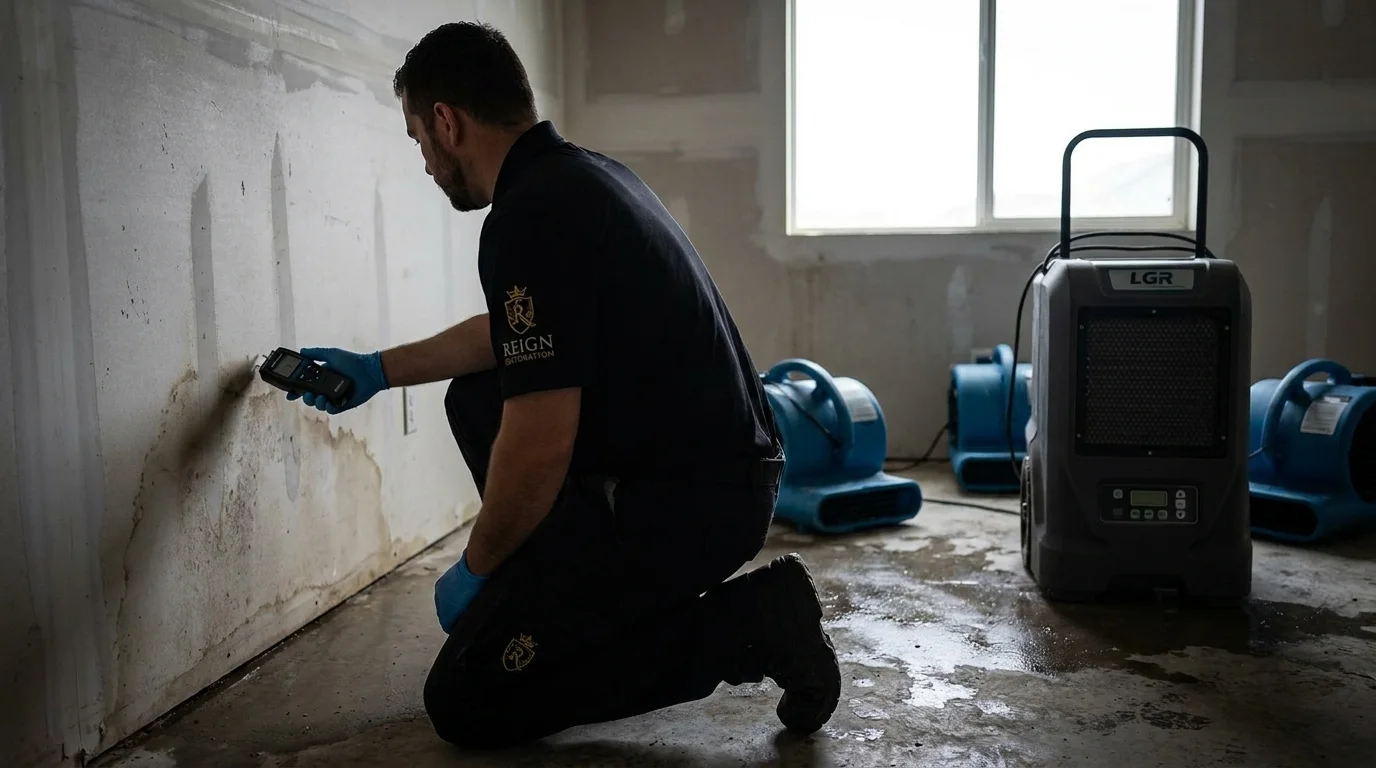
Every job starts with a moisture mapping inspection. We use thermal imaging cameras and calibrated moisture meters to trace water migration through walls, under flooring, and into ceiling assemblies, because water follows gravity and framing cavities, not the path you’d expect from looking at a wet floor. In University Park’s older homes, that often means water has traveled farther than the visible stain suggests.
From there, the process moves through four stages:
- Water extraction, truck-mounted and portable extractors pull standing water from hard and soft surfaces. In pier-and-beam homes, we access the crawl space to extract pooled water before it saturates the subfloor from below.
- Structural drying, high-capacity axial and centrifugal air movers combined with commercial-grade desiccant or refrigerant dehumidifiers create a controlled drying environment. We calibrate equipment placement to the specific wall and floor assemblies present, which differ significantly between a 1940s plaster-and-lath interior and a 2010s drywall build.
- Monitoring, we return daily to record moisture readings and adjust equipment. Drying is not complete until structural materials reach documented equilibrium moisture content, following the IICRC S500 standard.
- Controlled demolition if needed, when wall cavities or subfloor panels cannot dry in place, we perform targeted removal to expose wet framing and insulation. We document every step for your insurance claim.
Reign Restoration holds IICRC certification as a firm and carries IICRC WRT (Water Restoration Technician) credentials, so the drying plan is based on psychrometric science, not guesswork.
Reaching University Park from Royse City
Reign Restoration is based in Royse City and runs calls into University Park around the clock. The most direct route into the city runs west on I-30 to US-75 (Central Expressway) northbound, exiting at Lovers Lane or University Boulevard depending on which part of the city you’re in. The SMU campus area and the Preston Road corridor are both accessible within a short drive of those exits. Because University Park is a small, dense municipality, roughly 3.7 square miles, once a crew is in the city, they can reach Snider Plaza, Hillcrest Avenue, or the Caruth Hills neighborhood without significant additional drive time. We dispatch 24/7, so a call at 2 a.m. after a pipe bursts gets the same response as a call at noon.
University Park Insurance Coordination
Most water damage claims in University Park run through standard homeowners policies, and we work directly with all major carriers. We photograph affected materials before any demolition, generate moisture logs with timestamped readings, and produce a scope of work formatted for adjuster review. That documentation trail matters, insurance companies require evidence that drying was performed to a measurable standard, not just that fans were placed in a room. We also flag pre-existing conditions separately so that legitimate storm or plumbing damage isn’t conflated with deferred maintenance, which protects your claim from unnecessary disputes.
If your home is in an HOA community, some associations in University Park require written notification before exterior work or dumpster placement. We can help you identify those requirements and communicate with your HOA contact so the job doesn’t stall on an administrative detail.
Local Note
One thing that catches homeowners off guard in University Park’s older pier-and-beam stock: plaster walls, common in homes built before 1955, absorb water more slowly than modern drywall, but they also release it more slowly. That means the visible surface can feel dry to the touch while the brown coat and scratch coat layers are still holding significant moisture. We’ve seen plaster walls in the Caruth Hills area read normal on the surface and still show elevated moisture at depth four days into a drying job. If your restoration contractor is pulling equipment based on surface feel rather than calibrated meter readings, the job isn’t done, and that residual moisture is enough to support mold growth inside the wall assembly.
If you’re dealing with water damage anywhere in University Park, ZIP codes 75205 or 75225, call Reign Restoration at (214) 304-0621. We’ll assess the damage, explain exactly what drying will require, and get the process started before the clock runs any further against you.
Serving University Park from our Royse City headquarters — ★ 5.0 · 27 Google reviews
“Jerrot Gray was a delight to work with as our contractor. He is a man of integrity. Anytime we called or texted with a question he would get back to us immediately. We highly recommend him.” — Libba, January 2026Read our reviews on Google →
Water Damage Restoration in University Park: Service Coverage
Frequently Asked Questions
How fast can you arrive for water damage restoration in University Park?
How quickly can Reign Restoration reach University Park for a water damage emergency?
Are pier-and-beam homes in University Park harder to dry out after a water loss?
University Park's storm drains are decades old — does groundwater intrusion require different treatment than a burst pipe?
Does University Park's status as a separate municipality affect permits or inspections during water damage restoration?
How do plaster walls in older University Park homes affect the drying timeline?
Will my homeowners insurance cover water damage restoration in University Park?
Water Damage Restoration response in University Park
Most University Park calls see a technician on-site within 60 minutes from our Royse City headquarters.
Nearby & Related
- 24/7 Emergency Water Damage Restoration in Royse City
- Restoration Services in University Park
- 24/7 Emergency Fire Damage Restoration in University Park
- Mold Remediation in University Park
- 24/7 Emergency Water Damage Restoration in Allen
- 24/7 Emergency Water Damage Restoration in Dallas
- Contact Reign Restoration