
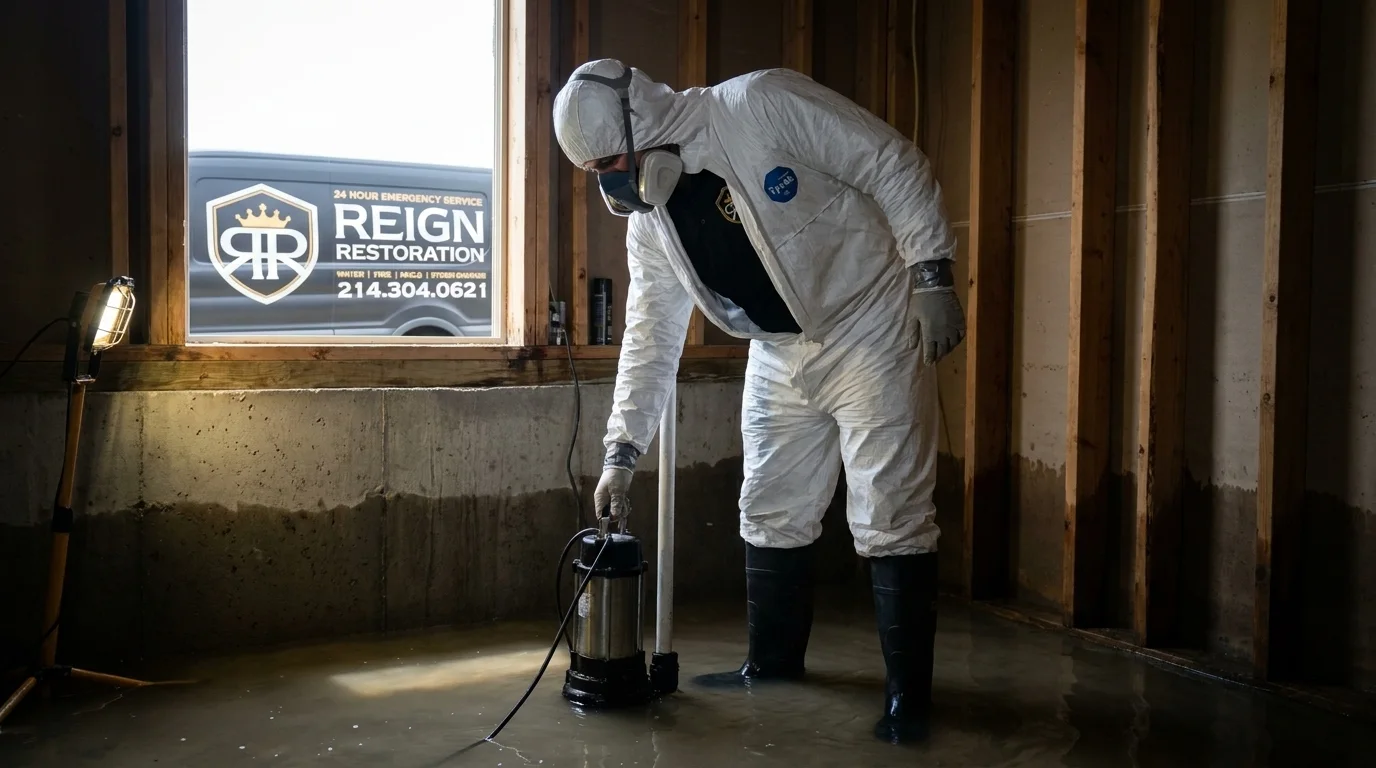
24/7 Emergency Basement Flooding Cleanup in Royse City, TX & Greater Dallas
24/7 emergency basement flooding cleanup across Royse City, TX & Greater Dallas. IICRC-certified, insurance billing accepted. Call (214) 304-0621.
Basement flooding in Royse City? Call (214) 304-0621 now, we answer 24/7 and send a crew to start extraction and basement water removal before the water climbs higher up your foundation walls.
A flooded basement rarely announces itself gently. It’s a sump pump that quit during a downpour, a foundation crack that let groundwater seep in overnight, or a supply line that burst while you were at work. By the time you notice the water, it’s often already wicked up into drywall, insulation, and stored belongings, and the clock on mold colonization has already started. Basement flooding cleanup in Royse City has its own set of challenges: clay-heavy soil that holds water against foundations long after a storm passes, and a mix of older slab homes and newer builds with finished basements that trap moisture behind framing.
What basement flooding cleanup actually involves
This isn’t a wet-vac-and-a-fan job. Standing water in a basement sits against concrete, block, or poured foundation walls that are porous enough to keep feeding moisture back into the space for days after the visible water is gone. Cleanup starts with pumping out standing water, then moves into extracting water trapped in carpet pad, baseboards, and any drywall that’s wicked moisture above the flood line. Equipment typically includes submersible pumps for anything deeper than an inch or two, truck-mounted or portable extraction units, and industrial dehumidifiers paired with air movers sized to the square footage and ceiling height of the space. Low basement ceilings and limited airflow mean drying often takes longer here than in an above-grade room with the same amount of water.
If the water came from a sewer backup or sat for more than 48 hours, it’s treated as a contaminated category and handled with containment and stricter disposal rules for affected materials, because at that point it’s a health consideration, not just a drying job.
Our process
- Water source identification and shutoff. Before anything else, we confirm whether the water is still actively entering (active leak, rising groundwater, sump failure) and address that first, otherwise drying efforts are wasted.
- Standing water extraction. Submersible pumps and extraction equipment remove bulk water from the slab, including water trapped under any flooring systems like laminate or carpet.
- Material assessment and removal. Drywall, insulation, and flooring that’s saturated beyond drying thresholds gets removed to stop ongoing moisture migration and reduce mold risk; materials that can be dried in place are flagged for monitoring instead.
- Structural drying and moisture monitoring. Dehumidifiers and air movers run until moisture meters confirm the slab, framing, and remaining wall materials are back to dry standard, not just surface-dry to the touch.
- Containment and treatment for Category 2/3 water. When the water is contaminated, affected areas get contained and treated with antimicrobial application before reconstruction begins.
What separates a good basement flooding response from a bad one
The most common mistake is declaring a basement “dry” based on how the carpet feels underfoot while the concrete slab underneath and the bottom few feet of drywall are still holding moisture. Moisture meters and hygrometers exist for this reason, drying per the IICRC S500 standard means checking those readings against dry standard, not eyeballing it. Another frequent miss is leaving baseboards and the bottom of drywall in place when they’ve wicked water well above the flood line, which just seals moisture in behind the wall and sets up a mold problem six weeks later.
Adjusters reviewing a basement flooding claim typically want documented moisture readings at the start and throughout drying, photos of the water line and affected materials before removal, and a clear explanation of why certain materials were removed versus dried in place. Cutting that documentation short is one of the fastest ways a claim gets delayed or underpaid.
What does basement flooding cleanup cost?
Costs vary with how much water was involved, how long it sat, and whether the basement is finished or unfinished. Every loss is different, which is why Reign Restoration provides a written scope of work before any work begins, so you know what’s included before you approve it. Homeowners insurance often covers basement flooding when the cause is sudden and accidental, like a burst pipe or sump pump failure, but typically excludes damage from surface flooding or long-term seepage, so it’s worth checking your policy’s water damage language.
| Scenario | Typical range |
|---|---|
| Small unfinished basement, clean water, caught early | $1,000 - $2,500 |
| Finished basement, several hundred square feet, carpet and drywall affected | $3,000 - $7,500 |
| Larger finished basement with contaminated water and material removal | $6,000 - $12,000 |
| Basement with extended standing water and mold growth requiring remediation | $8,000 - $18,000+ |
Seasonal & regional considerations
Royse City sees its share of heavy spring downpours, and the region’s clay soil doesn’t drain quickly, which means foundations can stay under hydrostatic pressure for days after a storm even once the rain stops. That pressure is what pushes water through hairline foundation cracks and around window wells that held fine in drier months. Basement drying in late summer runs slower too, since outdoor humidity is already high and dehumidifiers have more work to do pulling moisture out of the air before they can touch what’s in the walls.
Service area
We respond to basement flooding calls throughout Royse City and surrounding communities including Rockwall, Fate, and Greenville. If you’re outside these areas, call to confirm coverage.
If your basement has water in it right now, don’t wait for it to “dry on its own,” every hour it sits increases what has to be torn out later. Call (214) 304-0621 to schedule your basement water removal and start drying today.
Frequently Asked Questions
Does homeowners insurance cover basement flooding cleanup?
How long does basement drying usually take compared to other rooms?
How do I know if my basement water is considered contaminated?
Will you need to remove my drywall or can it be dried in place?
What's the risk if I just run fans and a dehumidifier myself?
Looking for the best basement flooding cleanup company in Royse City, TX & Greater Dallas?
Reign Restoration provides licensed and insured basement flooding cleanup across Royse City, TX & Greater Dallas from our Royse City office. Customers rate us 5.0 out of 5 stars across 26 Google reviews. We answer calls 24/7 — call (214) 304-0621 for immediate help.
Need Basement Flooding Cleanup now?
We respond 24/7 across Royse City, TX & Greater Dallas.
Related Coverage
- Our Restoration Services
- 24/7 Emergency Water Damage Restoration in Royse City
- Mold Remediation in Royse City
- Contact Reign Restoration
- Restoration Services in Allen
- Restoration Services in Caddo Mills
- Restoration Services in Dallas
- Restoration Services in Farmersville
- Restoration Services in Fate
- Restoration Services in Frisco
- Restoration Services in Garland
- Restoration Services in Greenville
- Restoration Services in Heath
- Restoration Services in Highland Park
- Restoration Services in Josephine
- Restoration Services in Lavon