
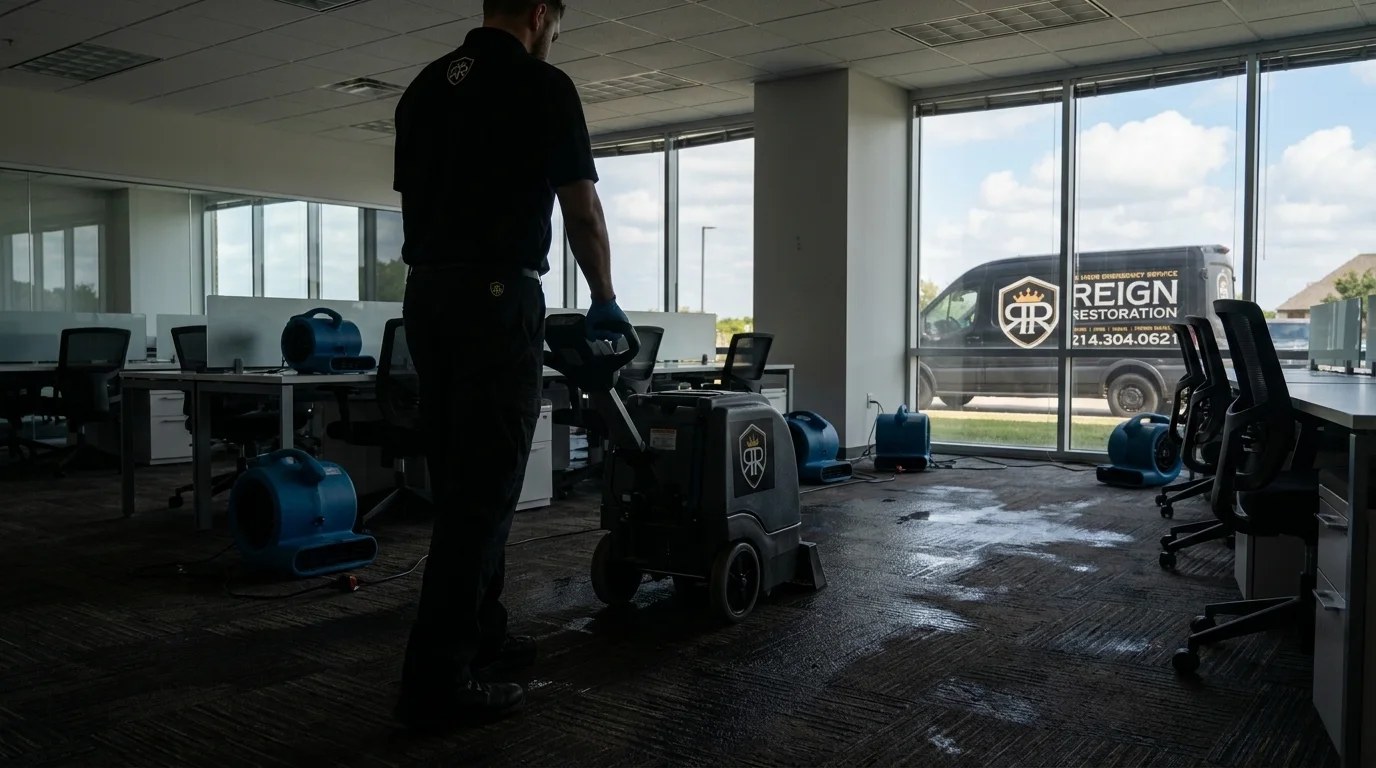
Commercial Restoration in Royse City
24/7 commercial restoration in Royse City and surrounding areas. IICRC-certified, insurance billing accepted. Call (214) 304-0621.
A pipe bursts in the break room over a holiday weekend, or a kitchen fire closes a strip-mall restaurant mid-lunch rush. Commercial losses carry a cost beyond the physical damage: lost revenue, tenant complaints, missed deadlines. Reign Restoration answers 24/7 for property managers, business owners, and facility teams across Royse City who need a crew that understands commercial buildings, not just residential ones, and can get a space back to operational as fast as the damage allows.
What commercial restoration actually involves
Commercial restoration covers the same core disciplines as residential work, water extraction, fire and smoke cleanup, structural drying, but the building systems and stakes are different. Suspended ceiling grids, raised server floors, HVAC return plenums, and metal-stud wall assemblies all behave differently under water or heat than a typical house. A single water event in an office building can travel across multiple suites through shared wall cavities or under raised flooring before anyone notices a stain. Fire and smoke cleanup in a retail or restaurant space often means addressing commercial kitchen hood systems, inventory loss, and surfaces coated in grease-laden soot that regular cleaning won’t touch. Timelines matter more here too: every day a storefront stays closed or an office floor is inaccessible is a day of lost income, so scope and sequencing get planned around reopening, not just drying out materials.
Our process
- Site assessment and access coordination. We walk the affected space with whoever manages the property, building owner, facility manager, or tenant, and map out which areas are affected, which are still usable, and who else needs to be looped in (other tenants, building security, a property management company).
- Mitigation specific to the loss. For water, that means extraction and moisture mapping behind commercial wall systems and under flooring; for fire, it means soot characterization and smoke odor control tailored to the materials involved, including commercial kitchen equipment and HVAC runs.
- Structural drying and stabilization with monitoring. Commercial-grade air movers and dehumidification equipment run with daily moisture readings logged, both to confirm the structure is drying correctly and to build the documentation a commercial insurance carrier or business interruption claim will ask for.
- Phased reconstruction when needed. Where possible, work is sequenced so part of the building can reopen while another section is still being finished, which matters a lot more in a commercial setting than a residential one.
- Final walkthrough and documentation handoff. You get a record of what was done, what was replaced, and the readings that show the space is dry or clean, useful for your records and for closing out the claim.
What separates a good commercial restoration response from a bad one
The mistakes that cost commercial property owners the most are usually about what gets missed, not what gets done wrong. Water that travels under a raised server floor or inside a metal stud wall can read dry at the surface while the cavity behind it stays wet for days, and if nobody pulls baseboard or checks behind drywall, mold starts colonizing within 24 to 48 hours in that hidden space. Adjusters reviewing commercial claims look for daily moisture logs, not a single end-of-job reading, because that’s what proves the drying was actually monitored rather than assumed. On fire jobs, treating a commercial kitchen fire the same as a house fire misses the grease-based soot layer that ordinary cleaning agents won’t break down, leaving odor and residue behind weeks later. A rushed reconstruction scope that skips life-safety system checks, fire sprinklers, alarm wiring, HVAC returns, can also create a problem that only surfaces during a final inspection or code walkthrough, delaying reopening further.
What does commercial restoration cost?
Commercial restoration costs vary widely based on square footage, how many building systems are involved, and whether the space needs to stay partially operational during work. The ranges below are typical industry figures, not a quote: every loss is different, and Reign Restoration provides a written scope of work before anything beyond emergency mitigation begins. Most commercial property policies cover sudden, accidental water and fire damage along with business interruption in many cases, though coverage specifics depend on your policy.
| Scenario | Typical range |
|---|---|
| Small office suite, water extraction and drying | $3,000 - $8,000 |
| Retail space, fire and smoke cleanup | $10,000 - $35,000 |
| Multi-tenant building, water damage affecting several units | $15,000 - $50,000 |
| Restaurant or commercial kitchen fire | $20,000 - $75,000 |
| Large warehouse or retail floor, storm or water damage | $25,000 - $100,000+ |
Seasonal & regional considerations
Royse City’s winters bring occasional hard freezes that put commercial plumbing and fire sprinkler lines at risk, particularly in older strip-mall or warehouse buildings with exposed piping in unconditioned spaces. Spring and summer storm season adds wind and hail exposure for flat and low-slope commercial roofing, which can lead to slow leaks that go unnoticed until they show up on a ceiling tile inside the building. North Texas humidity also means any wet commercial space, especially one with limited airflow like a stockroom or server closet, needs drying equipment running quickly to stay ahead of mold growth.
Service area
Reign Restoration is based in Royse City and works with commercial properties throughout the surrounding area, including Rockwall, Fate, Greenville, Terrell, and Forney. Whether it’s a single office suite or a multi-tenant retail building, we can usually be on-site quickly given our location in the region.
If your business has standing water, smoke damage, or storm damage right now, call Reign Restoration at (214) 304-0621 to get a commercial restoration crew assessing the site and building your scope of work.
Frequently Asked Questions
Does commercial property insurance cover water or fire damage restoration?
Can you work around our business hours so we don't have to close completely?
What happens to equipment, inventory, or server rooms during mitigation?
Do you document losses for business interruption claims, not just property damage?
If only one unit in a multi-tenant building is affected, do other tenants need to be involved?
Looking for the best commercial restoration company in Royse City?
Reign Restoration provides licensed and insured commercial restoration in Royse City, TX and the surrounding area. Customers rate us 5.0 out of 5 stars across 27 Google reviews. We answer calls 24/7 — call (214) 304-0621 for immediate help.
Need Commercial Restoration now?
We respond 24/7 across Royse City and surrounding TX cities.
Related Coverage
- Our Restoration Services
- Contact Reign Restoration
- Restoration Services in Allen
- Restoration Services in Caddo Mills
- Restoration Services in Dallas
- Restoration Services in Farmersville
- Restoration Services in Fate
- Restoration Services in Frisco
- Restoration Services in Garland
- Restoration Services in Greenville
- Restoration Services in Heath
- Restoration Services in Highland Park
- Restoration Services in Josephine
- Restoration Services in Lavon