
Industrial Restoration in Royse City
24/7 industrial restoration in Royse City and surrounding areas. IICRC-certified, insurance billing accepted. Call (214) 304-0621.
Water pooling around a compressor pad or smoke rolling through a warehouse racking system doesn’t wait for a convenient time. Industrial losses move fast: a burst supply line can flood thousands of square feet of production floor before a shift change, and fire suppression water left standing on a concrete slab starts wicking into insulation and conduit within hours. Reign Restoration answers 24/7 for industrial restoration in Royse City and works directly with facility managers to get operations back online, not just the building dried.
What industrial restoration actually involves
Industrial restoration covers the loss events that hit warehouses, manufacturing plants, distribution centers, and processing facilities differently than a house: larger volumes of water or smoke, more complex structures (steel frame, tilt-wall concrete, exposed truss), and equipment that’s often more valuable than the building itself. A single warehouse water loss might mean draining thousands of gallons from a slab-on-grade floor, pulling moisture out of wall cavities behind metal panel systems, and protecting electrical panels and machinery from corrosion before they’re ever touched by a technician. Fire losses in industrial settings bring their own complications: synthetic materials common in packaging, pallets, and insulation produce a denser, more corrosive soot than typical residential fires, and that residue can etch metal surfaces and electronics within days if it isn’t addressed. Timelines scale with square footage and loss type, but industrial jobs typically run in phases over multiple weeks rather than the few days common on a residential claim.
Our process
- Facility assessment and loss categorization. We walk the affected areas with facility management, identify the water category or soot type involved, and flag any immediate hazards to electrical systems, HVAC, or process equipment.
- Emergency mitigation and equipment protection. Bulk water extraction, temporary power shutoffs where needed, and protective measures for machinery, inventory, and racking systems come first, before drying or cleaning begins.
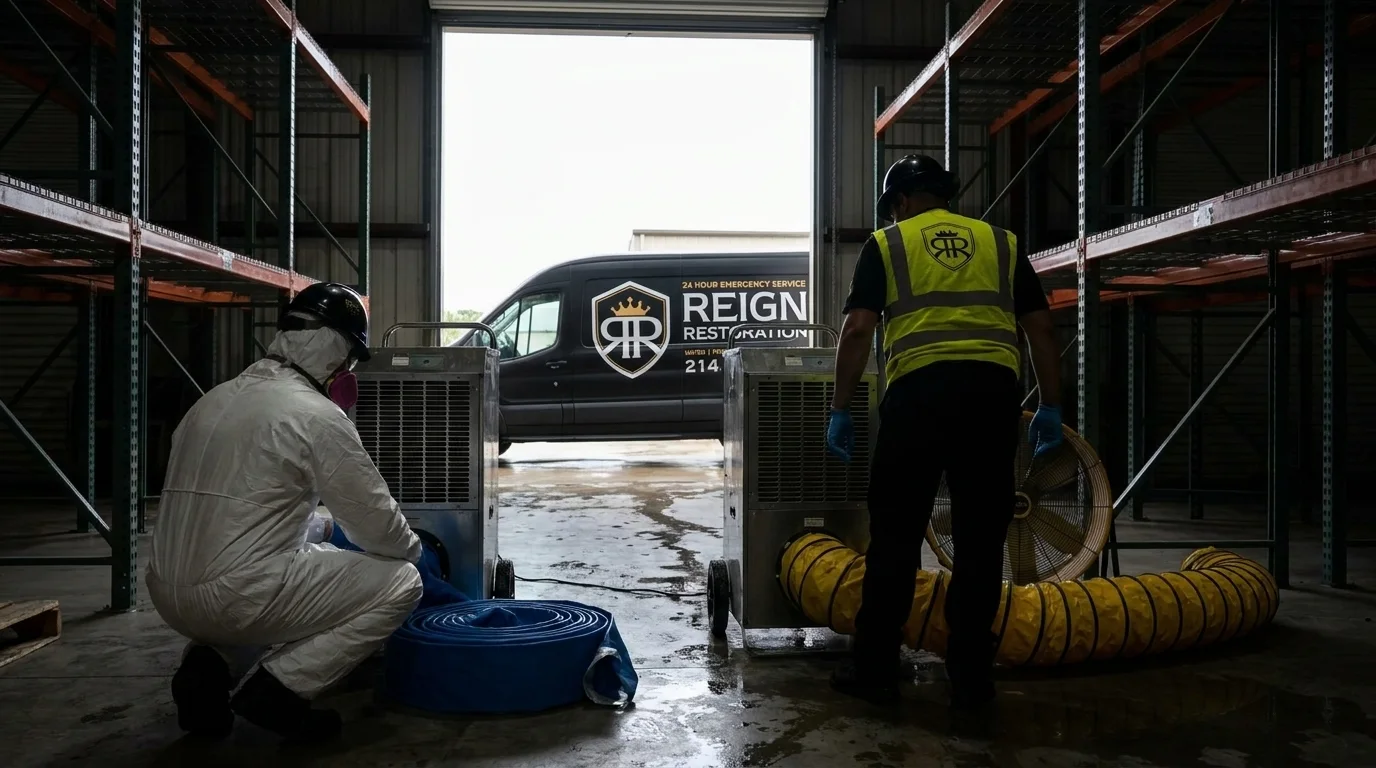
- Structural drying or soot removal, scaled to the space. Large-capacity dehumidifiers, axial air movers, and desiccant systems handle open-floor warehouse volumes; for fire losses, this phase includes thermal fogging and surface cleaning matched to the soot type.
- Moisture monitoring and clearance. We track drying progress across the affected footprint with moisture meters and document readings until materials reach acceptable levels, not just until surfaces look dry.
- Documentation handoff for your carrier and facility records. Photos, moisture logs, and scope notes go into a report built for both the insurance claim and your own maintenance file.
What separates a good industrial restoration response from a bad one
The biggest mistake in industrial losses is treating them like oversized residential jobs. A warehouse floor that reads “dry” on the surface can still hold moisture in the subfloor insulation, under epoxy coatings, or inside wall panel cavities, and that moisture doesn’t show up unless someone is actually checking with meters at multiple depths. Less experienced crews also tend to underestimate how corrosive industrial soot is to electronics and bare metal; waiting even a few extra days to treat exposed machinery can turn a cleaning job into a replacement cost. Adjusters reviewing industrial claims generally want to see categorized moisture logs, equipment inventories with pre-loss condition noted, and a clear line between mitigation work (covered to prevent further damage) and repair or replacement (a separate scope). A restoration plan that doesn’t separate those categories from day one tends to create friction later in the claim.
What does industrial restoration cost?
Costs vary widely based on square footage, the category of water or type of fire damage, and how much specialized equipment (production machinery, server rooms, cold storage units) is involved. Every industrial loss gets a written scope of work before Reign Restoration starts any billable work, so the numbers below are industry-typical ranges, not a quote for your facility.
| Scenario | Typical range |
|---|---|
| Small warehouse section, clean water extraction | $5,000 - $15,000 |
| Large manufacturing floor, extraction and structural drying | $20,000 - $75,000 |
| Industrial fire damage, structure and contents | $50,000 - $250,000+ |
| Mold remediation in industrial HVAC or ductwork | $10,000 - $40,000 |
| Emergency mitigation and equipment protection only | $3,000 - $12,000 |
Most commercial property policies cover sudden water and fire losses, including the cost of mitigation and structural repair, but coverage for business interruption, equipment replacement, and inventory loss depends heavily on your specific policy. Reign Restoration documents the loss in the format carriers expect and works with all major commercial insurance providers.
Seasonal & regional considerations
North Texas summers push HVAC and refrigeration systems hard, and a failed condensate line or rooftop unit in a Royse City warehouse can dump water into a plant for hours before anyone notices. Winter brings the opposite risk: a hard freeze followed by a quick thaw is a common cause of burst sprinkler lines and exposed supply piping in metal-frame industrial buildings, especially older structures with less insulation around plumbing runs. Spring storm season adds wind-driven rain and occasional hail that can compromise roof membranes on flat-roofed industrial buildings, letting water travel across open floor plans before it’s spotted.
Service area
Reign Restoration handles industrial restoration for facilities throughout Royse City and the surrounding Rockwall, Hunt, and Collin county area, including Rockwall, Fate, Greenville, Terrell, and the eastern edge of the Dallas-Fort Worth industrial corridor.
If water, smoke, or fire damage is affecting your facility right now, call (214) 304-0621 to get a technician assessing the loss and documenting it for your insurance carrier.
Frequently Asked Questions
Does commercial or industrial property insurance cover this kind of damage?
How is water categorized differently in an industrial loss versus a home?
Can a warehouse or plant stay partially operational during restoration?
How long does structural drying take in a large industrial space?
What's different about cleaning industrial fire and smoke damage compared to a house fire?
Looking for the best industrial restoration company in Royse City?
Reign Restoration provides licensed and insured industrial restoration in Royse City, TX and the surrounding area. Customers rate us 5.0 out of 5 stars across 26 Google reviews. We answer calls 24/7 — call (214) 304-0621 for immediate help.
Need Industrial Restoration now?
We respond 24/7 across Royse City and surrounding TX cities.
Related Coverage
- Our Restoration Services
- Contact Reign Restoration
- Restoration Services in Allen
- Restoration Services in Caddo Mills
- Restoration Services in Dallas
- Restoration Services in Farmersville
- Restoration Services in Fate
- Restoration Services in Frisco
- Restoration Services in Garland
- Restoration Services in Greenville
- Restoration Services in Heath
- Restoration Services in Highland Park
- Restoration Services in Josephine
- Restoration Services in Lavon