
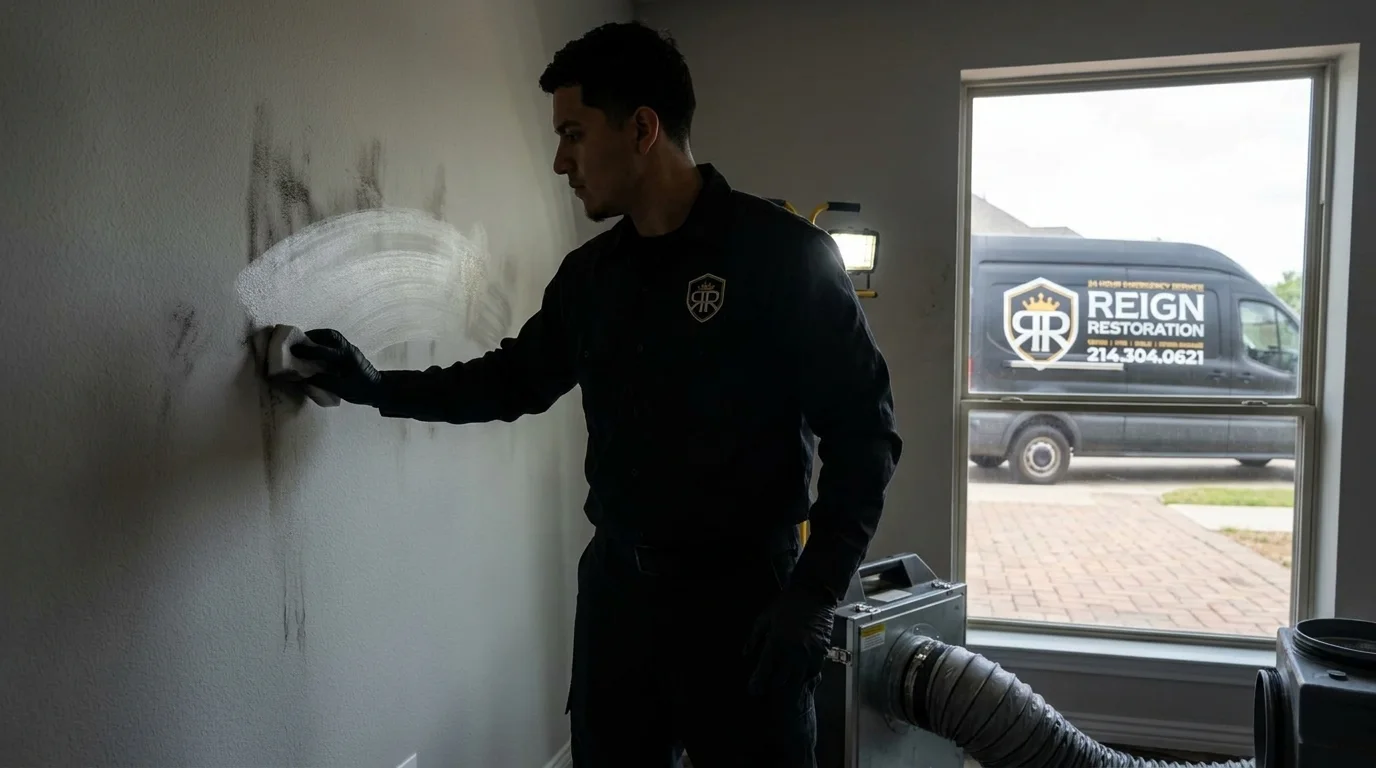
24/7 Emergency Smoke Damage Restoration in Royse City
24/7 emergency smoke damage restoration in Royse City and surrounding areas. IICRC-certified, insurance billing accepted. Call (214) 304-0621.
Smoke damage emergency in Royse City? Call (214) 304-0621 now. We answer 24/7, and smoke residue only gets harder to remove the longer it sits on drywall, cabinetry, and HVAC components.
Smoke doesn’t stay where the fire was. Within hours of a kitchen fire, a grease flare-up, or a wildfire smoke event drifting through open vents, residue has already settled into carpet fibers, migrated through return air ducts, and bonded to painted surfaces two or three rooms away from the actual flame. The smell that lingers after a fire is out isn’t cosmetic. It’s an acidic, oily film that keeps reacting with humidity and heat long after the smoke has cleared, which is why DIY wipe-downs and store-bought odor sprays almost always fail.
What smoke damage restoration actually involves
Smoke damage restoration is a chemistry problem as much as a cleaning problem. The approach depends entirely on what burned: a protein fire (meat, fat, cooking oil) leaves a nearly invisible, yellowish, extremely pungent film that’s hard to see but easy to smell. A synthetic fire (furniture foam, electronics, plastics) leaves thick, black, sticky soot that smears if you touch it. Wildfire smoke cleanup is its own category, usually a dry, powdery residue that travels through HVAC systems and settles in attics and wall cavities far from any visible damage.
Each type requires a different cleaning agent, a different mechanical approach, and in many cases different PPE for the crew. Equipment on a typical smoke residue cleanup job includes HEPA vacuums, dry chemical sponges for porous surfaces, degreasing agents for protein residue, thermal foggers to re-create the conditions that let smoke penetrate in the first place (which helps the deodorizing agent reach the same hidden spaces), and in heavier jobs, hydroxyl generators or ozone treatment in a sealed, unoccupied space. Timeline for a contained, single-room smoke event typically runs two to four days; whole-house jobs with HVAC contamination and content pack-out run longer.
Our process
- Soot characterization. Before any cleaning begins, we identify whether the residue is protein-based, synthetic, or a wildfire/ash profile. This determines the cleaning agents and technique used on every subsequent step, since the wrong cleaner can set soot into a surface instead of lifting it.
- Pre-cleaning and structural triage. Loose soot is removed with HEPA vacuums and dry sponges before any liquid cleaning agent touches a surface. Wet-wiping first is one of the most common mistakes that smears soot deeper into drywall texture and grout lines.
- Thermal fogging and deodorization. Thermal fogging recreates the heat and particle size of the original smoke event, allowing deodorizing agents to penetrate the same cracks, fibers, and cavities the smoke originally reached. Surface spraying alone doesn’t solve odor that’s embedded this way.
- HVAC and duct assessment. If the fire or smoke event involved a running HVAC system, ducts, coils, and filters are inspected and cleaned separately, since recirculated smoke is a common source of odor that returns weeks after the visible cleanup is done.
- Contents handling and final odor verification. Salvageable contents are cleaned, deodorized, or packed out depending on material and damage level, and the space is re-checked for odor before the job is closed out.
What separates a good smoke damage response from a bad one
The most common mistake is treating smoke damage as a surface cleaning job. Wiping visible soot off walls without addressing what’s inside the wall cavity, the duct system, or the subfloor means the odor comes back, often worse, once the weather turns humid and residue reactivates. A second common error is using an all-purpose cleaner on protein soot, which can smear the film into porous drywall rather than lifting it.
Insurance adjusters reviewing a smoke damage claim typically look for documented soot characterization (protein vs. synthetic vs. wildfire ash), moisture and odor readings before and after treatment, and an itemized scope separating cleanable contents from items requiring replacement. A restoration report that just says “cleaned and deodorized” without that documentation tends to generate disputes during the claims process. We document soot type, affected materials, and treatment method as part of every scope, which keeps the claim moving rather than stalling on a coverage question.
What does smoke damage restoration cost?
Costs vary widely depending on how far the smoke traveled, whether HVAC systems were contaminated, and whether contents need pack-out and off-site treatment. The ranges below reflect typical industry figures, not a quote: every loss is different, and Reign Restoration provides a written scope of work before any cleaning begins.
| Scenario | Typical range |
|---|---|
| Single room, light surface residue | $500 - $1,500 |
| Kitchen fire, multi-room smoke spread | $2,000 - $6,000 |
| Whole-house smoke damage with HVAC contamination | $6,000 - $15,000 |
| Wildfire smoke infiltration, no structural fire | $1,500 - $5,000 |
| Contents pack-out, cleaning, and storage | $1,000 - $4,000 |
Homeowners insurance typically covers smoke and soot damage from a covered fire event, including cleaning, deodorization, and contents restoration, though coverage for wildfire smoke infiltration without direct flame contact can vary by policy.
Seasonal & regional considerations
North Texas summers bring higher ambient humidity that can reactivate residual smoke odor in walls and ductwork that weren’t fully treated the first time. Wildfire smoke events, whether from regional grass fires or drift from larger fires further out, tend to show up as a fine, dry residue in attics and HVAC systems rather than visible soot on walls, which is why a duct inspection matters even when the house itself never caught fire.
Service area
Reign Restoration handles smoke damage restoration services for Royse City and the surrounding communities, including Rockwall, Fate, Greenville, and the greater Rockwall County area.
If smoke odor or visible residue is lingering after a fire, cooking incident, or regional wildfire smoke event, call (214) 304-0621 to begin smoke and soot removal before the residue sets permanently into your home’s surfaces.
Frequently Asked Questions
Does homeowners insurance cover smoke damage restoration?
What's the difference between protein soot and synthetic soot?
Why does smoke odor come back weeks after the visible cleanup is done?
Can wildfire smoke damage a house that never had a fire in it?
Do I need to replace smoke-damaged contents or can they be cleaned?
Looking for the best smoke-damage-restoration company in Royse City?
Reign Restoration provides licensed and insured smoke-damage-restoration in Royse City, TX and the surrounding area. Customers rate us 5.0 out of 5 stars across 27 Google reviews. We answer calls 24/7 — call (214) 304-0621 for immediate help.
Need smoke-damage-restoration now?
We respond 24/7 across Royse City and surrounding TX cities.
Related Coverage
- Our Restoration Services
- Contact Reign Restoration
- Restoration Services in Allen
- Restoration Services in Caddo Mills
- Restoration Services in Dallas
- Restoration Services in Farmersville
- Restoration Services in Fate
- Restoration Services in Frisco
- Restoration Services in Garland
- Restoration Services in Greenville
- Restoration Services in Heath
- Restoration Services in Highland Park
- Restoration Services in Josephine
- Restoration Services in Lavon
- The Fire Damage Restoration Process, Explained