
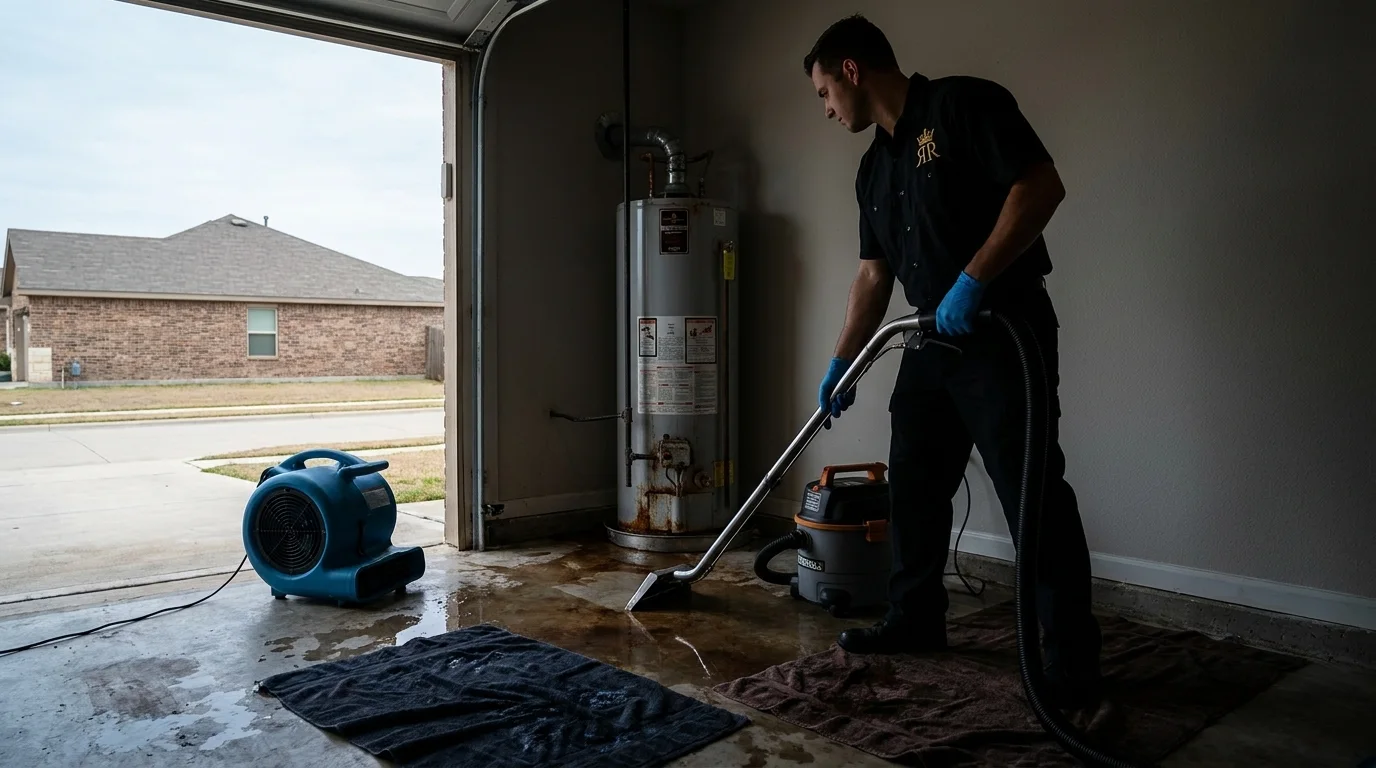
24/7 Emergency Water Heater Flood Cleanup in Royse City
24/7 emergency water heater flood cleanup in Royse City and surrounding areas. IICRC-certified, insurance billing accepted. Call (214) 304-0621.
Water heater flooding in Royse City? Call now, we answer 24/7. A failed water heater can put 40 to 80 gallons on the floor in minutes, and if the tank’s been leaking slowly behind a closet door for weeks, the damage is often worse than what you can see on the surface.
Most water heater floods fall into one of two categories: the sudden burst, where a tank seam or fitting lets go all at once and water spreads fast across flooring and into adjacent rooms, or the slow leak, where a corroded tank or loose T&P valve drips for days or weeks before anyone notices the warped baseboards or musty smell. Both require different handling, and both are different from a generic water damage call because the source is pressurized, mineral-heavy water that’s often been sitting in a hot, enclosed utility closet or garage.
What water heater flood cleanup actually involves
Water heater failures usually happen in a garage, utility closet, or attic, spaces with limited drainage and absorbent materials nearby: drywall, baseboards, subfloor, insulation. The first job is stopping the source, which means shutting off the water supply line and the gas or electric power to the unit before any extraction starts. From there, the work is standard Category 1 or 2 water mitigation, but the equipment placement is dictated by the tight, often awkward space where the tank failed.
If the water sat for more than 24 to 48 hours before discovery, which is common with slow leaks behind a tank, the moisture has usually migrated into subfloor, baseboards, and sometimes wall cavities through wicking. That changes the drying plan from a straightforward surface dry to a multi-day structural dry with monitoring, because wood and drywall hold moisture longer than they show on a surface moisture meter reading.
Our process
- Source shutoff and safety check. Before anything else, the water supply and power to the unit are shut off. If it’s a gas water heater, the gas line gets checked too. This step prevents re-flooding and removes the electrical hazard of standing water near an active unit.
- Extraction and tank removal coordination. Standing water is extracted from the floor and any adjacent rooms it traveled into. The damaged unit typically needs to be disconnected and moved before flooring and baseboard can be properly dried underneath.
- Moisture mapping behind walls and under flooring. Because water heaters are often tucked against a wall, moisture meters and sometimes thermal imaging get used to check how far the water traveled into drywall, insulation, and subfloor, not just what’s visible.
- Drying and dehumidification per IICRC S500 standard. Air movers and dehumidifiers are set based on the affected square footage and material type, with daily moisture checks until readings return to a dry standard, not just until the floor looks dry.
- Repair scope for affected materials. Baseboard, drywall, flooring, or subfloor that absorbed water gets documented and scoped for repair or replacement, with photos for the insurance file.
What separates a good water heater flood response from a bad one
The most common mistake is treating a water heater flood like a simple mop-up job because the source gets fixed quickly. The visible puddle on the garage floor or closet is often the smallest part of the problem. Water travels along subfloor seams and under baseboard faster than it spreads across a visible surface, and a crew that doesn’t check moisture content behind the baseboard or under the vinyl plank near the unit will miss saturation that turns into a mold problem within 48 to 72 hours.
Another frequent miss is skipping documentation of the tank itself. Insurance adjusters want to know whether the failure was sudden (often covered) versus long-term neglect or lack of maintenance (sometimes disputed), so photos of the tank, the corrosion pattern, and the surrounding damage matter for the claim, not just for the repair.
Good operators also account for mineral content in water heater discharge. Hard water deposits and sediment that come out with the flood water can stain grout, flooring, and baseboard in ways that plain water doesn’t, so cleaning and neutralizing those residues is part of a proper job, not an afterthought.
What does water heater flood cleanup cost?
Costs vary depending on how long the water was present before discovery, how far it traveled, and whether it reached subfloor or wall cavities. Every loss is different, which is why Reign Restoration provides a written scope of work before any cleanup begins. Most homeowners insurance policies cover sudden and accidental water heater failures, though gradual leaks tied to lack of maintenance are sometimes excluded, so it’s worth checking your specific policy language.
| Scenario | Typical range |
|---|---|
| Caught fast, minimal spread, hard flooring only | $900 - $2,200 |
| Standing water into adjacent room, carpet or laminate affected | $2,200 - $4,500 |
| Slow leak, subfloor and baseboard saturation | $3,500 - $7,000 |
| Water reached wall cavities or insulation | $4,500 - $9,000 |
| Flood in finished basement or lower level utility space | $5,000 - $12,000 |
Seasonal & regional considerations
Royse City’s hot summers put extra strain on water heaters that sit in garages or attics where ambient temperatures climb well above indoor living space, accelerating tank corrosion over time. Many homes in the area also have hard water, which speeds up sediment buildup inside the tank, a common factor in slow failures that show up as a gradual leak rather than a sudden burst.
Service area
Reign Restoration handles water heater flood cleanup for homes and businesses in Royse City and surrounding communities across Rockwall and Collin counties. Response and equipment staging are coordinated based on the property’s location and the extent of the water intrusion.
If a water heater has failed or is leaking right now, shutting off the supply line and power to the unit is the first move while help is on the way. Call (214) 304-0621 to start water heater flood cleanup and get a documented scope of the damage before more material gets affected.
Frequently Asked Questions
Does homeowners insurance cover water heater flood damage?
How do I know if my water heater leak is sudden or has been happening slowly?
Can mold grow from a water heater leak that went unnoticed for a while?
Do you handle removing or disconnecting the failed water heater, or just the cleanup?
What should I do immediately after discovering a water heater leak or burst?
Looking for the best water-heater-flood-cleanup company in Royse City?
Reign Restoration provides licensed and insured water-heater-flood-cleanup in Royse City, TX and the surrounding area. Customers rate us 5.0 out of 5 stars across 27 Google reviews. We answer calls 24/7 — call (214) 304-0621 for immediate help.
Need water-heater-flood-cleanup now?
We respond 24/7 across Royse City and surrounding TX cities.
Related Coverage
- Our Restoration Services
- Contact Reign Restoration
- Restoration Services in Allen
- Restoration Services in Caddo Mills
- Restoration Services in Dallas
- Restoration Services in Farmersville
- Restoration Services in Fate
- Restoration Services in Frisco
- Restoration Services in Garland
- Restoration Services in Greenville
- Restoration Services in Heath
- Restoration Services in Highland Park
- Restoration Services in Josephine
- Restoration Services in Lavon