
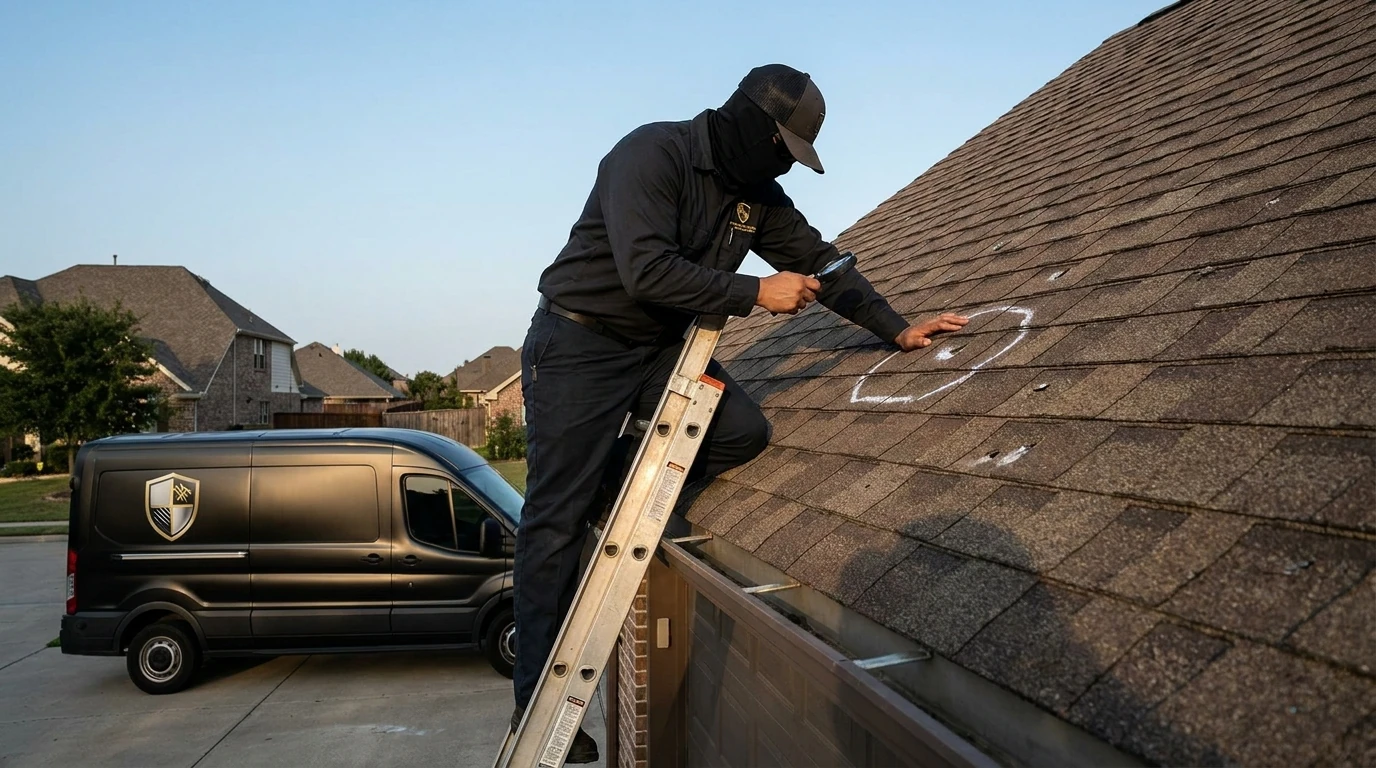
TL;DR: In Royse City, TX, a straightforward hail damage roof repair typically costs $450 to $4,500, while a full roof replacement after a significant hailstorm runs $9,500 to $22,000 depending on shingle class and roof size. Most Texas homeowners policies cover hail damage under the wind/hail peril, but they often carry a percentage deductible (1% to 5% of the dwelling coverage limit) instead of a flat dollar amount, which changes what you actually pay before coverage kicks in.
If a spring hailstorm just rolled through Rockwall County and left dime- to golf-ball-sized dents across your shingles, you’re probably trying to answer two things before you call anyone: what the repair will actually cost, and whether insurance covers it. Royse City sits in one of the more hail-active corridors of North Texas, and most roofs here are architectural shingle over OSB decking on homes built since the late 1990s, which affects both what a repair involves and what it costs.
How much does hail damage roof repair cost in Royse City?
Most hail damage repairs in this area fall between $450 and $4,500 for spot repairs, while a full tear-off and replacement typically runs $9,500 to $22,000 depending on roof size and shingle class. The wide range exists because “hail damage” covers everything from a handful of bruised shingles on one slope to a roof where hits are spread across every plane.
Small jobs, replacing a dozen damaged shingles, resealing a vent boot, patching a flashing strip, sit at the low end. A full replacement on a typical 2,000 to 2,500 square foot Royse City roof, torn off down to the decking and reroofed with new architectural shingles, lands in the middle to upper end of that range once labor, disposal, and code-required underlayment are factored in.
What’s the typical price breakdown?
Here’s how the costs generally shake out by scenario, based on typical North Texas roofing pricing:
| Scenario | Typical Cost Range |
|---|---|
| Minor repair: a dozen damaged shingles on one slope, no decking damage | $450 - $1,800 |
| Moderate repair: multiple slopes, flashing and vent boot replacement | $1,800 - $4,500 |
| Full tear-off and replacement, standard architectural shingles (2,000-2,500 sq ft roof) | $9,500 - $16,000 |
| Full replacement with impact-resistant Class 4 shingles | $13,500 - $22,000 |
| Decking replacement add-on, per damaged sheet of OSB/plywood | $75 - $150 per sheet |
| Interior water damage remediation from a leak that went undetected | $1,500 - $6,000+ depending on affected area |
These are typical industry ranges, not a quote. Every roof’s actual price depends on an on-site measurement and a written scope.
What makes the cost go up or down?
The final number depends on how many squares (100 square foot units) need work, what shingle class you choose, and whether the decking underneath took damage too. A roof with hits concentrated on one slope and sound decking costs far less than one with hail spread across all planes and a few soft spots from standing moisture.
Shingle class matters more than most homeowners expect. Standard 3-tab and architectural shingles cost less upfront but are also more likely to need full replacement after a significant hail event. Impact-resistant Class 4 shingles cost more per square but hold up to hail better, and many Texas insurers offer a premium discount for installing them, worth asking your carrier about directly.
Other cost drivers: roof pitch (steep roofs take longer and need more safety equipment), the number of penetrations like skylights and chimneys, how long the damage went unnoticed before repair (a slow leak behind a cracked shingle can turn a $1,500 repair into a $5,000 remediation job once drywall and insulation are involved), and local permit and disposal fees.
Will insurance cover hail damage, and what’s the deductible?
Most standard Texas homeowners policies cover sudden hail damage to a roof as a named peril, but the deductible usually isn’t a flat dollar amount. Many Texas wind/hail policies use a percentage deductible, typically 1% to 5% of your dwelling coverage limit, rather than the $500 to $2,000 flat deductible common on the rest of the policy.
That distinction matters a lot in practice. On a home insured for $300,000, a 2% wind/hail deductible works out to $6,000 you pay before coverage starts, not the $1,000 flat deductible some homeowners assume. Check your declarations page for a separate “wind/hail” or “named storm” deductible line before you plan around a repair budget. The Texas Department of Insurance publishes guidance on how storm claims and these deductibles typically work.
Also worth knowing: most policies pay actual cash value upfront and release the remaining depreciation (recoverable depreciation) once the repair is completed and documented, so the insurance check you first receive is rarely the full repair cost.
Should you repair or replace?
The decision usually comes down to roof age, how much of the surface is affected, and what your insurance adjuster’s scope says. A roof under 10 years old with hail hits confined to one or two slopes is often a good repair candidate. An older roof, or one with hail damage spread broadly across every plane, is more often a full replacement, both because patch shingles rarely match or seal as well on an aged roof and because most adjusters write for full slope replacement once hits are spread across a meaningful portion of that plane.
Our related guide on hail damage roof inspections in Royse City covers exactly what an inspector looks for and how that inspection translates into the adjuster’s scope of work.
What happens when you call for an inspection?
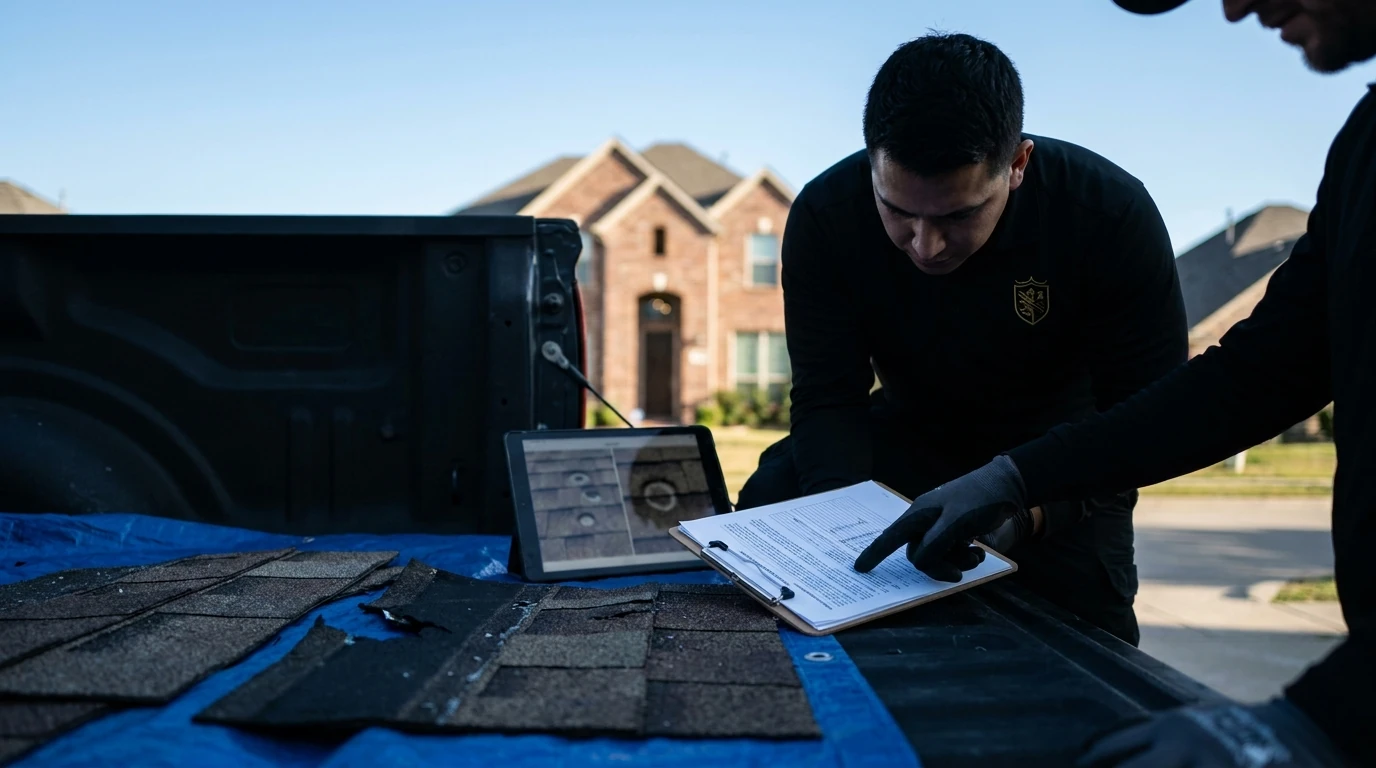
A professional roof inspection after hail starts with a visual survey of every slope, chalk-marking confirmed hail hits, checking metal flashing and vents (which dent more visibly than shingles and help confirm the storm’s severity), and checking the attic for decking damage or active leaks. That documentation becomes the basis for the insurance claim.
From there, the typical sequence runs: 1) document the damage with photos and measurements, 2) file the claim with your carrier, 3) meet the adjuster on-site, ideally with your contractor present to compare scopes, 4) agree on a written scope of repair, and 5) schedule the work. Royse City homeowners often bring in a local licensed roofing contractor, like Reign Restoration, to walk the adjuster meeting, make sure the written scope reflects what the roof actually needs, and handle the repair or replacement once it’s approved.
If a hail-damaged roof has already let water into the attic or ceiling, that part of the job shifts from roofing to water damage mitigation, drying the affected area before it becomes a mold problem.
Getting a written scope before any work starts protects you either way, repair or replacement. Schedule a roof inspection by calling (214) 304-0621 or request a written estimate through our roofing services page.
About Reign Restoration
Reign Restoration is an IICRC Certified Firm (license MRC2276) based in Royse City, Texas, serving Rockwall, Fate, Rowlett, Wylie, and the surrounding DFW suburbs. The team handles storm and hail damage restoration, roofing, water damage restoration, mold remediation, fire and smoke damage restoration, and reconstruction, operating 24/7 for emergency response across the region.