
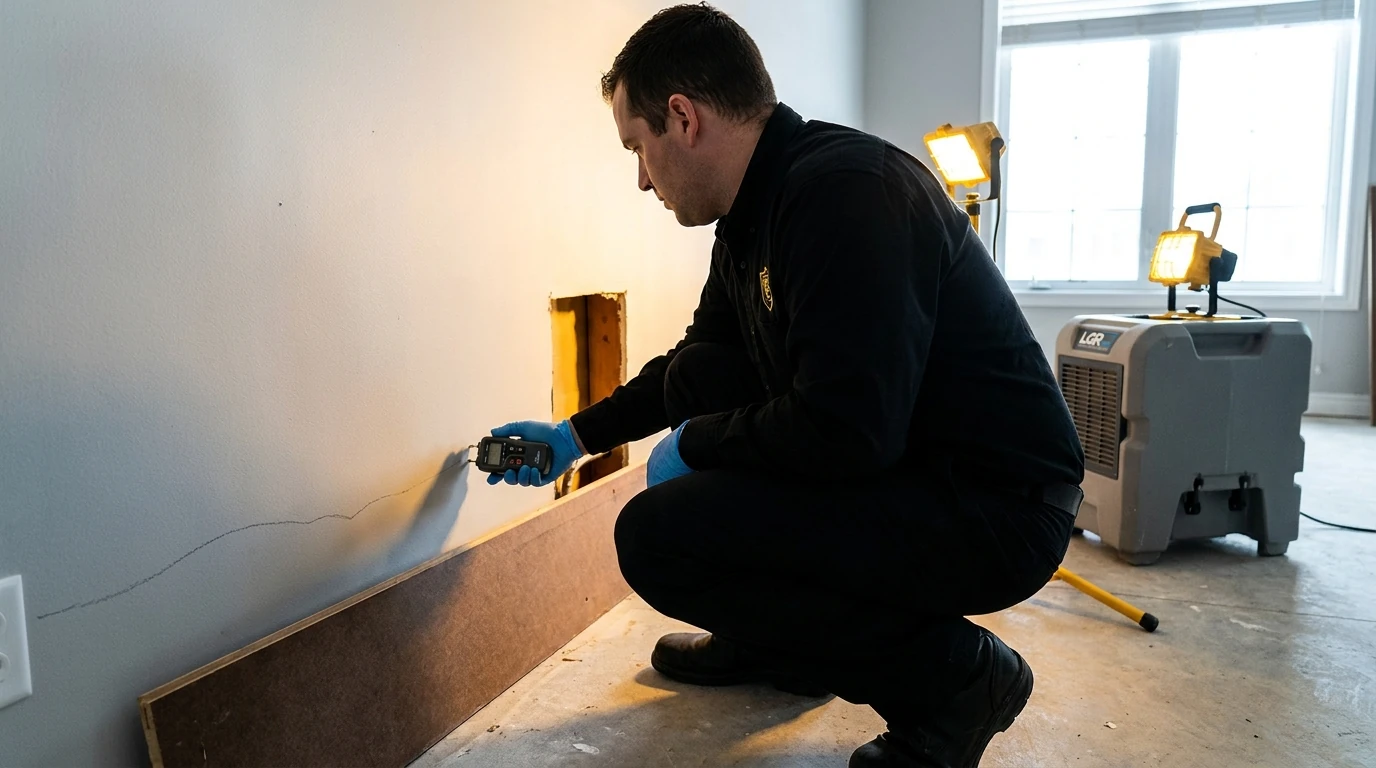
TL;DR: Swollen, buckled, or dark-stained baseboard almost always means water has been sitting inside the wall cavity behind it. MDF trim absorbs moisture fast and shows damage before drywall does, making it a reliable early warning sign. The real question is where the water came from and how far it has traveled. A restoration crew will remove the trim, drill the wall cavity, and measure moisture levels before deciding whether a flood cut or targeted drying is the right fix.
You noticed the baseboard in your bathroom or laundry room is puffing out at the bottom, or there’s a dark stain creeping up the paint. Maybe the drywall feels soft when you press it two to four inches above the floor. You’re not looking at a paint problem. You’re looking at a symptom, and the actual problem is somewhere behind that wall.
This post walks through how to read what baseboard damage is telling you, what’s typically happening inside the wall, and why the right fix almost always involves more than a coat of primer.
Why does baseboard swell and stain when there’s water damage?
Baseboard swells because most modern trim is made from MDF, medium-density fiberboard, which is compressed wood fiber and resin. MDF is affordable and takes paint beautifully, but it has almost no moisture resistance. When water reaches it from the floor, from a slow leak behind the wall, or from a slab leak below, the fibers absorb it and expand. The bottom edge of the baseboard swells first, then the face begins to bow away from the wall.
Solid wood trim behaves differently. It warps and cups rather than swelling uniformly, and it takes longer to show visible damage. Either way, visible trim damage means the water has been present long enough to saturate the material, which usually means the drywall and the wall cavity behind it are already wet.
Dark staining at the base of the trim is often mold beginning to colonize the paper facing of the drywall behind it. The EPA notes that mold can begin growing on wet building materials within 24 to 48 hours, so staining that has been there for days or weeks is a serious flag.
What does swollen baseboard actually mean for the wall behind it?
Swollen baseboard almost always means the drywall directly behind it is wet, and the wall cavity may be as well. Drywall is gypsum board with a paper facing. That paper facing is a food source for mold. When water wicks up from the floor or migrates through the base of the wall, it saturates the bottom few inches of drywall first, then travels upward by capillary action.
A trained technician uses a non-invasive moisture meter on the wall face and a pin-type meter on the drywall edge to map exactly how high the moisture has traveled. In a typical bathroom or kitchen leak, readings above 17% moisture content in drywall indicate active saturation. Readings above 25% mean the material is unlikely to dry in place without mechanical help, and may need to come out.
If you press the drywall two to four inches above the baseboard and it feels soft or spongy, the paper facing has already begun to delaminate. That wall section will not dry to a safe level on its own.
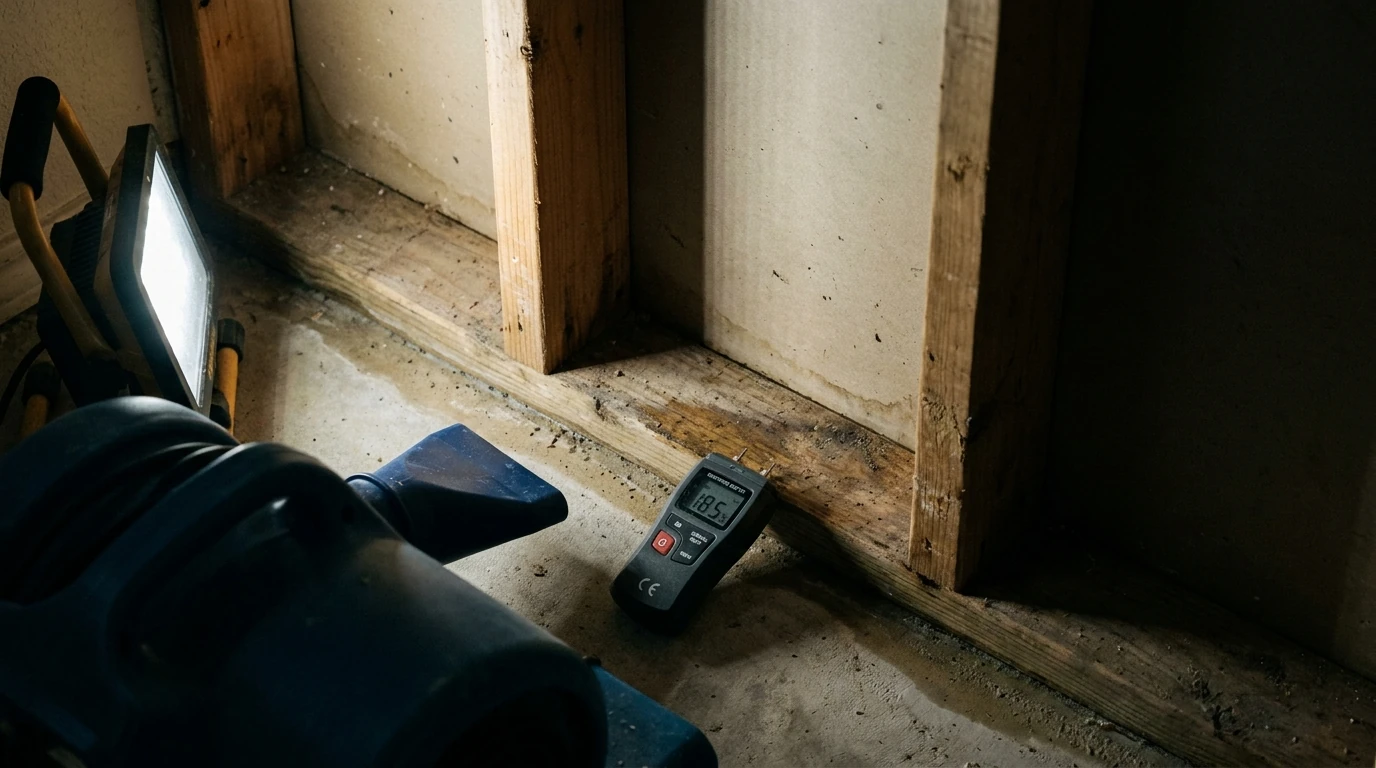
What is a slab leak and why does baseboard show it first?
A slab leak is a break or pinhole in a water supply or drain line running beneath a concrete slab foundation. In North Texas, where most homes built after the 1970s sit on slab-on-grade foundations over reactive Houston Black clay, slab leaks are one of the most common causes of baseboard damage that homeowners mistake for a surface problem.
The water from a slab leak wicks upward through the concrete and into the flooring and base of the wall. Because the leak is below the floor, there is often no visible pooling. The first sign is frequently a warm spot on the floor (from a hot-water line), a slight increase in the water bill, or swelling at the very bottom of the baseboard where it meets the floor.
If your baseboard is swelling at the floor line but you cannot identify a surface source of water, a plumber should check for a slab leak before a restoration crew begins drying work. Drying a wall fed by an active leak accomplishes nothing.
How does a restoration crew actually fix water-damaged walls and baseboard?
A restoration crew follows a documented process based on the IICRC S500 Standard for Professional Water Damage Restoration. The steps are:
- Source confirmation. The crew identifies and confirms the water source is stopped before any drying begins. If a plumber is needed, they coordinate.
- Moisture mapping. Non-invasive and pin-type meters map the full extent of saturation in the wall, floor, and subfloor. This determines the scope of the work.
- Trim removal. The baseboard comes off carefully. If it is MDF and visibly swollen, it is almost always replaced rather than dried in place, because MDF does not return to its original dimensions after saturation.
- Flood cut or targeted cavity drying. A flood cut is a horizontal cut across the drywall, typically 12 to 18 inches above the visible damage line. It exposes the wall cavity so air movers and dehumidifiers can dry the framing, insulation, and back of the remaining drywall. If the framing is wet, it needs to reach below 19% moisture content before the wall can be closed. If the cavity is clean and the saturation is limited, the crew may drill small holes in the drywall at the base and inject air directly into the cavity without a full cut.
- Mold assessment. If the damage is more than a few days old or if visible growth is present, a mold assessment follows. The EPA recommends that mold covering more than 10 square feet be handled by a professional. See the related post on signs of hidden mold for what to look for before the crew arrives.
- Drying verification. The crew returns daily to log moisture readings until all materials reach dry standard. This documentation matters for your insurance claim.
- Rebuild. Once the structure is dry and clear, new drywall, tape, texture, and baseboard go back in. This is where general contracting picks up the work.
The reason a restoration firm removes the trim and opens the wall instead of just repainting is simple: paint over wet drywall traps moisture and accelerates mold growth behind the surface. It looks fixed for a few weeks and then the problem returns, worse.
What about bathroom baseboard water damage specifically?
Bathroom baseboard damage has a short list of usual causes: a slow toilet supply line leak, a failing wax ring seal, grout failure in the shower or tub surround, or a leaking drain connection. All of them feed water to the base of the wall slowly enough that the damage is well established by the time the homeowner notices the trim.
In bathrooms, the wall behind the tub or shower surround is often cement board or greenboard, which handles moisture better than standard drywall. But the adjoining walls, the ones around the toilet or vanity, are usually standard drywall, and they are the ones that show baseboard damage first.
If the baseboard damage is in a bathroom, check the toilet base for any movement or rocking, check the supply line connection at the shut-off valve, and press the grout lines in the tub surround. Any softness or give in the surround tile means water has been getting behind it. Related reading: what to do in the first 24 hours after water damage.
For a full picture of what water damage restoration involves and what it typically costs in Texas, see the TX cost guide.
If mold is already visible behind the trim or the damage has been present for more than a few days, mold remediation will likely be part of the scope. Reign Restoration holds IICRC AMRT certification (Applied Microbial Remediation Technician) and IICRC WRT certification (Water Restoration Technician), and is licensed in Texas under MRC2276. Their crews handle water mitigation, mold remediation, and the general contracting rebuild as a single coordinated project, so you are not managing three separate contractors.
If your baseboard is telling you something, call (214) 304-0621 to schedule a moisture assessment.
About Reign Restoration
Reign Restoration is an IICRC Certified Firm serving Royse City, Rockwall, Rowlett, Garland, Dallas, and surrounding North Texas communities (Texas Mold Remediation Contractor license MRC2276). Their IICRC-certified technicians handle water damage restoration, mold remediation, fire and smoke damage restoration, storm damage restoration, odor removal, roofing, and general contracting rebuild work. Available 24/7 for emergency response.