
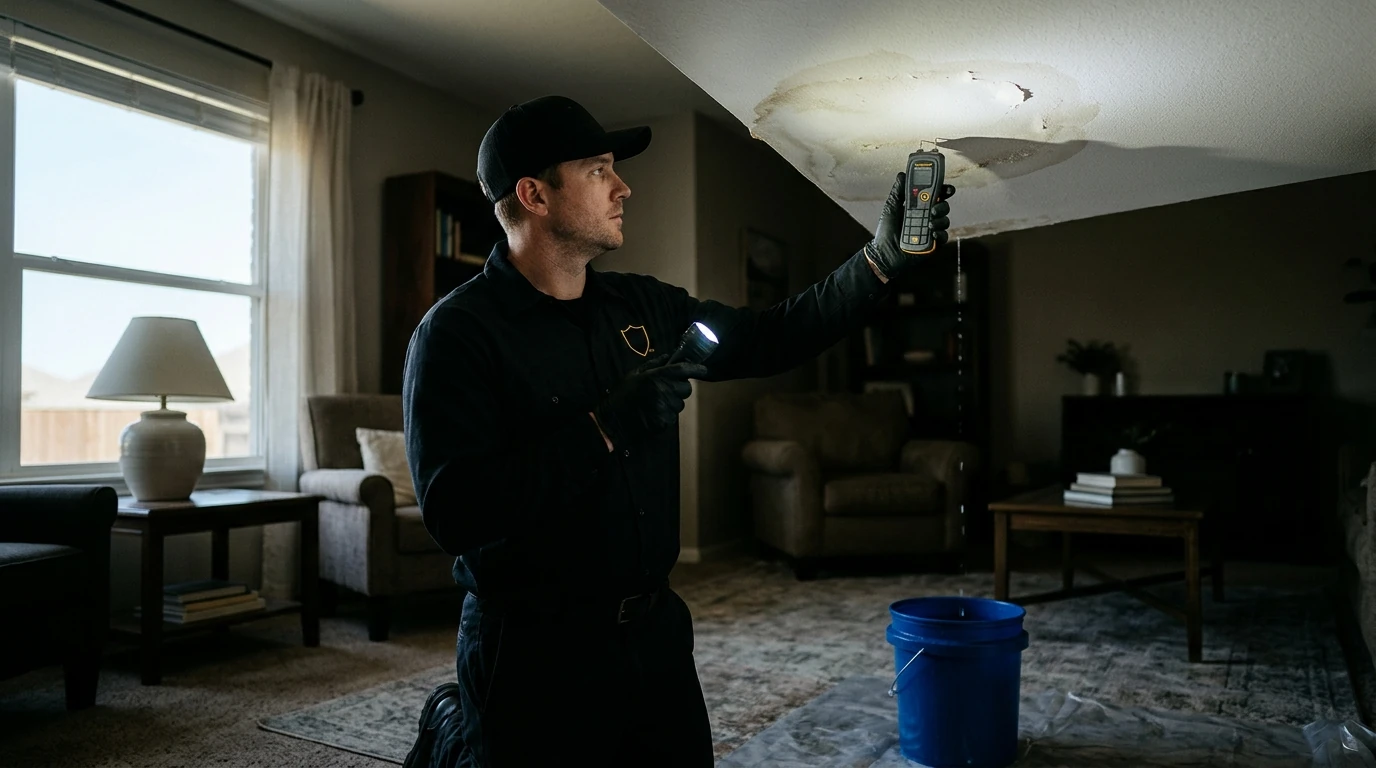
If a storm just rolled through Royse City and you’re watching a wet spot spread across your ceiling, or worse, you’re staring at a bulge that’s getting bigger, here’s what matters right now: get people and anything valuable out from under it, cut power to that room at the breaker, and don’t touch the stain. The roof can wait a few hours. A ceiling that collapses on someone can’t.
What should you do in the first 60 seconds?
Move fast on safety, not on repairs. Shut off power to the affected room or circuit at the breaker panel if the leak is anywhere near a light fixture, ceiling fan, or outlet; water and live wiring is the fastest way a roof leak becomes a serious injury.
Next, set a bucket, trash can, or stack of towels under the active drip and slide furniture or anything irreplaceable out of the room. Do not climb a ladder to inspect a sagging or bulging section from below; a soaked ceiling can fail without warning, and the weight of wet drywall and insulation is heavier than it looks.
If the storm is still active outside, stay inside. Roof inspections and tarping wait until the wind and lightning pass.
Who do you call first, a roofer, a plumber, or a restoration company?
For water coming through a ceiling after a storm, call a company that handles storm damage, roofing, and water damage restoration under one roof, rather than coordinating three separate businesses while your ceiling is still wet. A storm restoration company such as Reign Restoration can tarp the roof, extract the water, dry the structure, and put the ceiling back, so nothing sits half-finished between contractors.
A roofer alone can tarp and eventually re-shingle, but most roofing companies don’t run commercial-grade dehumidifiers or dry wet insulation to an industry drying standard. A plumber only matters here if the water is coming from a pipe, not the roof. For storm-driven ceiling leaks in Rockwall County and the surrounding area, the fastest path is one crew that handles the tarp, the extraction, and the rebuild in sequence.
Should you poke a hole in a bulging ceiling?
A small, controlled hole in the center of a bulging ceiling can be the safer option, but only as a last resort and only done carefully. Trapped water adds weight fast, and a controlled release through a deliberate opening is often less damage than an uncontrolled collapse across the room.
If you decide to do it yourself because a crew is hours out, stand to the side of the bulge, never directly under it, and use a long screwdriver or similar tool rather than your hand. Set a bucket or tub directly below first. Never attempt this near a light fixture, ceiling fan box, or any visible wiring; if the bulge is near either one, back away and wait for a professional instead. When in doubt, don’t. A ceiling that’s holding steady and just dripping slowly is safer left alone until a crew can assess the attic side and decide whether a controlled drain point is even necessary.
What happens after the water stops: tarping, drying, and the ceiling repair?
Once the active leak is under control, the job runs in three phases: emergency tarping of the roof opening, extraction and structural drying, and finally the ceiling put-back. Skipping or rushing any one of them is how a one-day leak turns into a mold problem weeks later.
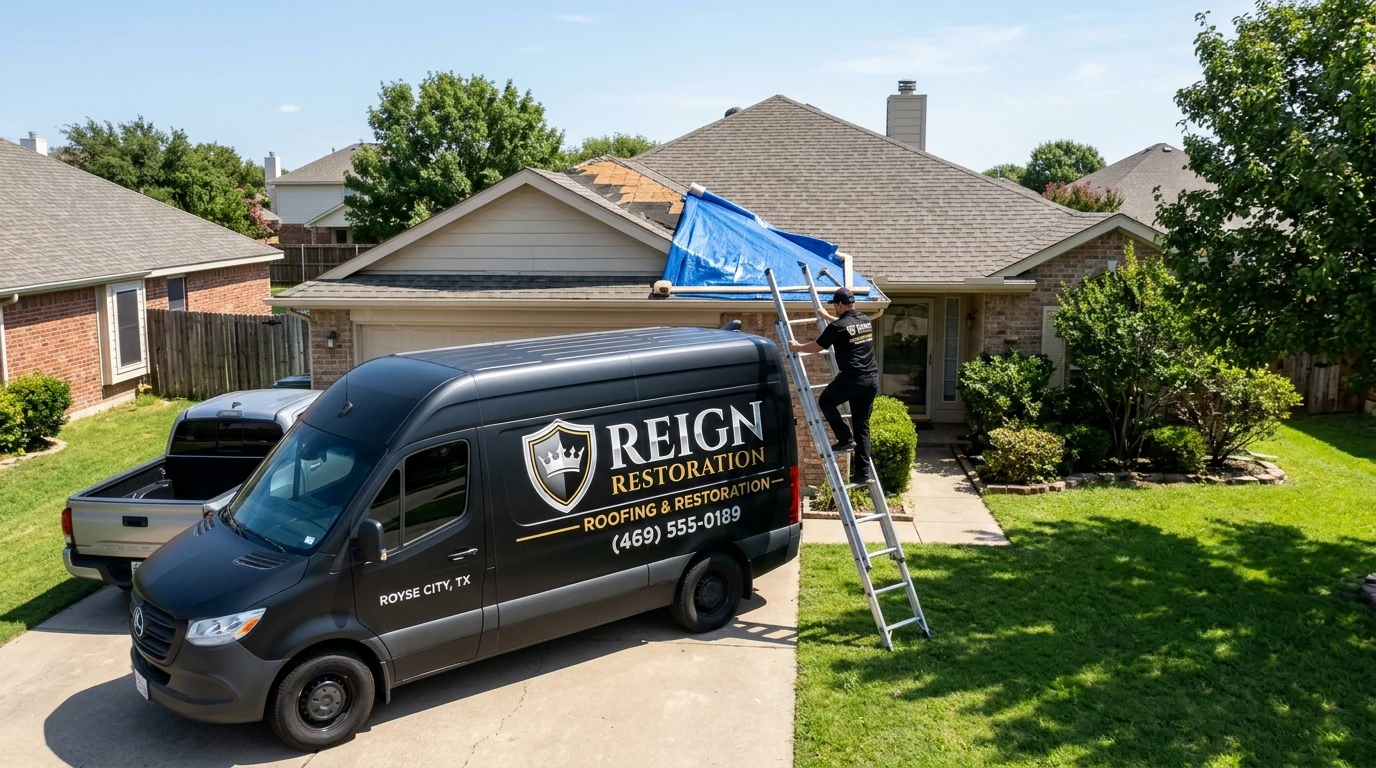
A tarp, properly nailed and sealed over the damaged section of roof decking, stops new water from entering while the permanent roof repair gets scheduled, see roofing for what that repair typically involves. Inside, wet insulation above the ceiling usually has to come out rather than be dried in place, since saturated fiberglass or cellulose loses its R-value and rarely dries evenly. The ceiling drywall itself often needs a section removed if it’s sagging, staining, or soft to the touch, which is covered in more detail in our ceiling water damage repair guide.
Drying the remaining structure is done to the ANSI/IICRC S500 standard, using air movers and a dehumidifier sized to the room, with moisture readings checked daily until the framing and remaining drywall are back to a dry baseline, not just surface-dry. Most roof leaks that are caught within a day or two start out as relatively clean water, but wind-driven rain that’s picked up attic dust and sat inside wet drywall for more than 24 to 48 hours should be treated as contaminated and handled accordingly. For the full process on extraction and drying beyond just the ceiling, see water damage restoration. If you want a sense of real numbers for a job like this, our breakdown of ceiling water damage repair costs in Royse City covers typical ranges by severity.
How do you file the claim for a storm roof leak?
Most homeowners policies cover sudden, storm-caused roof damage and the resulting interior water, but they draw a hard line against damage from a roof that was already failing or poorly maintained. Document the ceiling, the attic, and the roof before anything is torn out or tarped, with timestamped photos from multiple angles, and keep every receipt once mitigation starts.
Call your insurer to open the claim once the leak is stopped and the area is documented, not before; starting mitigation promptly is actually part of your duty under the policy, and waiting too long to dry things out can hurt the claim more than starting it a few hours late. The Texas Department of Insurance has a dedicated page on storm claims that’s worth reading before you sign anything. For the mechanics of what’s typically covered versus excluded, the Insurance Information Institute’s overview of standard homeowners coverage is a solid plain-language reference. A written scope of work with photos and moisture readings, which a restoration crew documents as part of the job, becomes the backbone of that claim.
If the ceiling is actively dripping, the bucket’s filling faster than you’d like, or you’re not sure whether that bulge needs a controlled release tonight, call Reign Restoration at (214) 304-0621 and describe exactly what you’re seeing. They’ll walk you through what to do before a crew can get there.