
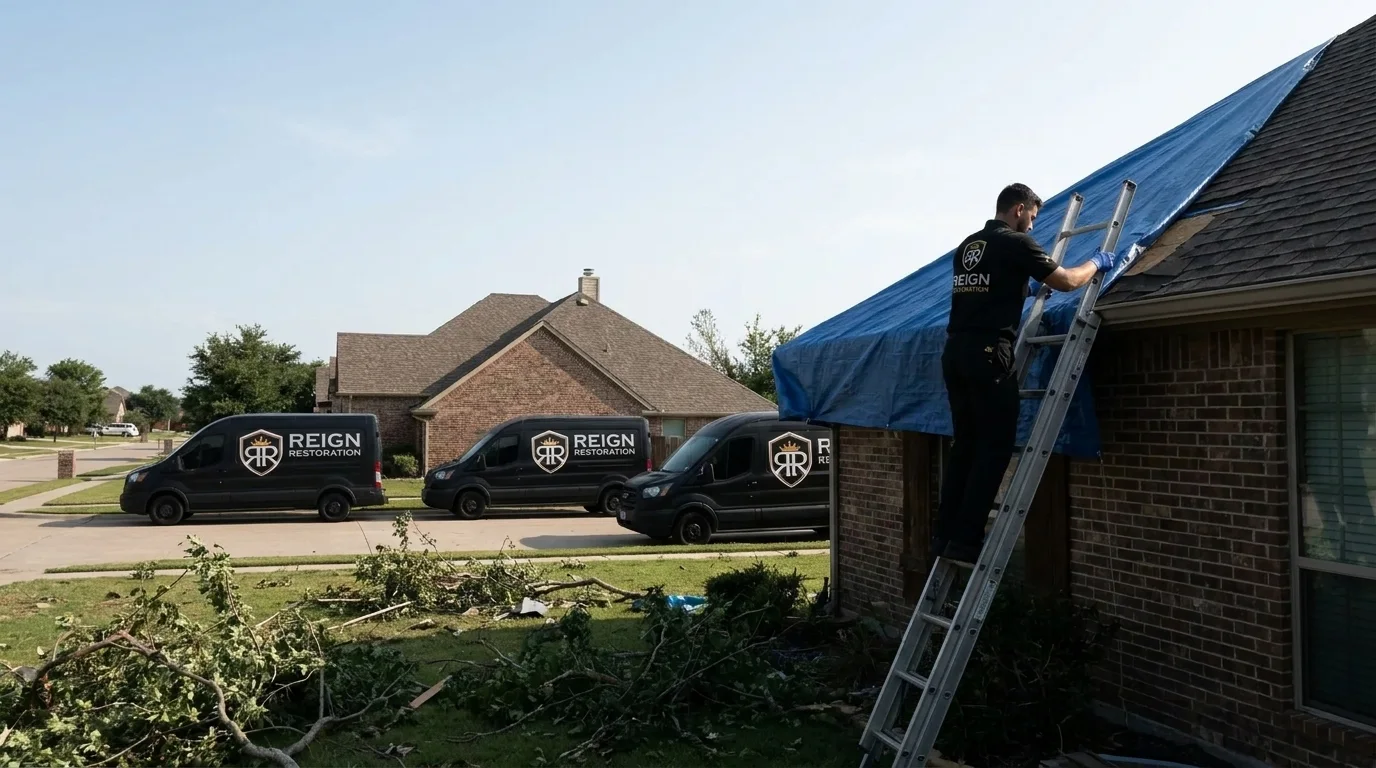
24/7 Emergency Storm Damage Restoration in McKinney
24/7 emergency storm damage restoration in McKinney, TX. IICRC-certified, insurance billing accepted. Call (214) 304-0621.
Our IICRC-certified technicians are dispatched from our Royse City, TX headquarters and are typically on-site in McKinney within 60 minutes of your call.
Storm damage emergency in McKinney? We answer 24/7. Call now and our crew heads out to secure the property and stop further damage.
When a severe thunderstorm or tornado-warned supercell rolls across Collin County, McKinney takes the hit differently depending on which side of US 75 you’re on. The 1890s–1920s Folk Victorians and Craftsman bungalows clustered around Historic Downtown McKinney sit on pier-and-beam foundations with open crawlspaces, storm-driven rain wicks up through those gaps fast, and the old-growth lumber framing holds moisture far longer than modern engineered wood. West of the highway, master-planned communities like Stonebridge Ranch and Trinity Falls face their own exposure: wide-open lots, younger tree canopies with shallow root systems, and miles of impact-rated roofing that still gets tested every hail season. Reign Restoration responds to storm damage calls across McKinney 24/7, (214) 304-0621.
Why McKinney Properties Are Especially Vulnerable to Severe Weather
North Texas sits squarely in Tornado Alley’s eastern corridor, and Collin County averages some of the highest annual hail-day counts in the state. But the local risk isn’t just about frequency, it’s about what the storms find when they arrive.
The historic housing stock near the Old Collin County Courthouse square presents a specific challenge: wide, deep porches that catch wind like a sail, original wood-frame windows with single-pane glass, and drain lines predating PVC that can back up when storm volume overwhelms them. A straight-line wind event that barely registers on radar can peel porch fascia, shatter original glazing, and push water through gaps that modern weatherstripping would have sealed.
Further west, Wilson Creek and Honey Creek carry mapped floodplain toward the East Fork of the Trinity. Subdivisions built along those drainages, including parts of Craig Ranch, can see sheet flooding that overtops driveways and enters garages within minutes of a heavy rain event. Slab foundations in those areas don’t have the crawlspace exposure of the older homes, but water that enters through garage doors or HVAC penetrations spreads silently under luxury vinyl plank before anyone notices.
Hail is the third variable. McKinney’s rapid growth means a wide range of roof ages across the same ZIP code, a 2022 architectural shingle on a new build in Painted Tree handles a 1.5” hailstone very differently than a 15-year-old 3-tab on a resale in Tucker Hill.
Our Storm Damage Restoration Process in McKinney
Every storm job starts with a documented scope, not a verbal estimate, but a line-item record of every affected surface, because Collin County insurance adjusters and McKinney HOA architectural review boards both require written documentation before repair approvals move forward.
Step 1, Emergency stabilization. Tarping compromised roofs, boarding broken windows, and extracting any standing water before secondary damage compounds the loss. On pier-and-beam homes near the historic district, we check crawlspaces immediately, storm water pooling under the floor system is the fastest path to mold colonization, which can begin within 24–48 hours in a Texas summer.
Step 2, Moisture mapping. We use thermal imaging and calibrated moisture meters to trace water migration through walls, subfloors, and ceiling assemblies. In older plaster-and-lath construction common downtown, moisture readings behave differently than in drywall, plaster holds water longer and releases it slowly, so drying timelines are extended and we adjust our equipment placement accordingly.
Step 3, Structural drying and debris removal. Industrial air movers, desiccant dehumidifiers, and where needed, injectidry systems for wall cavities. Tree limb removal and debris clearing happen in parallel so the structure is accessible for the trades that follow.
Step 4, Reconstruction coordination. Roof repairs, window replacement, siding, and interior finishes, all permitted through the City of McKinney’s building department where required. We carry IICRC certification as a firm, and our technicians hold WRT, AMRT, and FSRT credentials, which insurers and adjusters recognize when reviewing the claim file.
Reaching McKinney from Royse City
Royse City sits roughly 25 miles southeast of McKinney via SH-66 to US 380 or I-30 to US 75 North. Both routes are well-traveled corridors our crews run regularly. For addresses in the 75071 ZIP, covering much of the newer development in Trinity Falls and Painted Tree, US 380 west from Royse City feeds directly into McKinney’s northern grid. Historic Downtown and the neighborhoods around Adriatica Village are accessible via US 75 to Virginia Street or Louisiana Street. Because we operate 24/7, a storm that hits at 2 a.m. gets the same dispatch as one at noon.
McKinney Insurance and HOA Coordination
Most storm damage claims in McKinney run through standard homeowners’ policies, but two local wrinkles come up repeatedly. First, several master-planned communities, including parts of Stonebridge Ranch, have HOA architectural guidelines that specify approved roofing materials, exterior paint palettes, and even fence replacement standards. A repair that satisfies the insurance adjuster may still require HOA approval before work begins. We’ve navigated that process enough times to build the documentation package both parties need upfront.
Second, Collin County’s growth has brought a wave of newer carriers and surplus-lines policies into the market. Some of those policies have named-storm exclusions or separate wind/hail deductibles that surprise homeowners at claim time. We walk through the policy language with you before scoping the job so there are no billing surprises.
Local Note
One pattern we’ve seen repeatedly on pier-and-beam homes within a few blocks of the Chestnut Square Historic Village area: original cast-iron drain cleanouts are often buried or paved over during decades of landscape updates, and storm surge that backs up through those lines has nowhere obvious to exit. When we’re called to one of these addresses after a heavy rain event, we probe for cleanout access before assuming the water entry is roof-related, finding a blocked drain line early has saved more than one homeowner from a misdiagnosed and under-scoped insurance claim.
If a storm has hit your McKinney property, call Reign Restoration at (214) 304-0621, we’re available around the clock and can begin emergency stabilization the same day. The longer storm damage sits in a Texas summer, the more the secondary losses compound. Don’t wait on the adjuster’s timeline to start protecting the structure.
Serving McKinney from our Royse City headquarters — ★ 5.0 · 27 Google reviews
“I couldn’t be happier with the results. Very professional, incredibly knowledgeable, and the craftsmanship exceeded my expectations. It’s rare to find this level of quality and care these days. Highly recommended!” — Jasmine, January 2026Read our reviews on Google →
Storm Damage Restoration in McKinney: Service Coverage
Frequently Asked Questions
How fast can you arrive for storm damage restoration in McKinney?
How quickly can Reign Restoration reach the Stonebridge Ranch or Trinity Falls areas after a storm?
Do McKinney HOA communities like Stonebridge Ranch require special documentation before storm repairs can begin?
Are the older pier-and-beam homes near Historic Downtown McKinney harder to dry out after storm water intrusion?
What does storm damage restoration actually involve beyond tarping a roof?
My property is in the 75071 ZIP code near the floodplain along Wilson Creek — does that affect how my storm damage claim is handled?
Will my homeowners insurance cover storm damage restoration in McKinney?
Storm Damage Restoration response in McKinney
Most McKinney calls see a technician on-site within 60 minutes from our Royse City headquarters.