
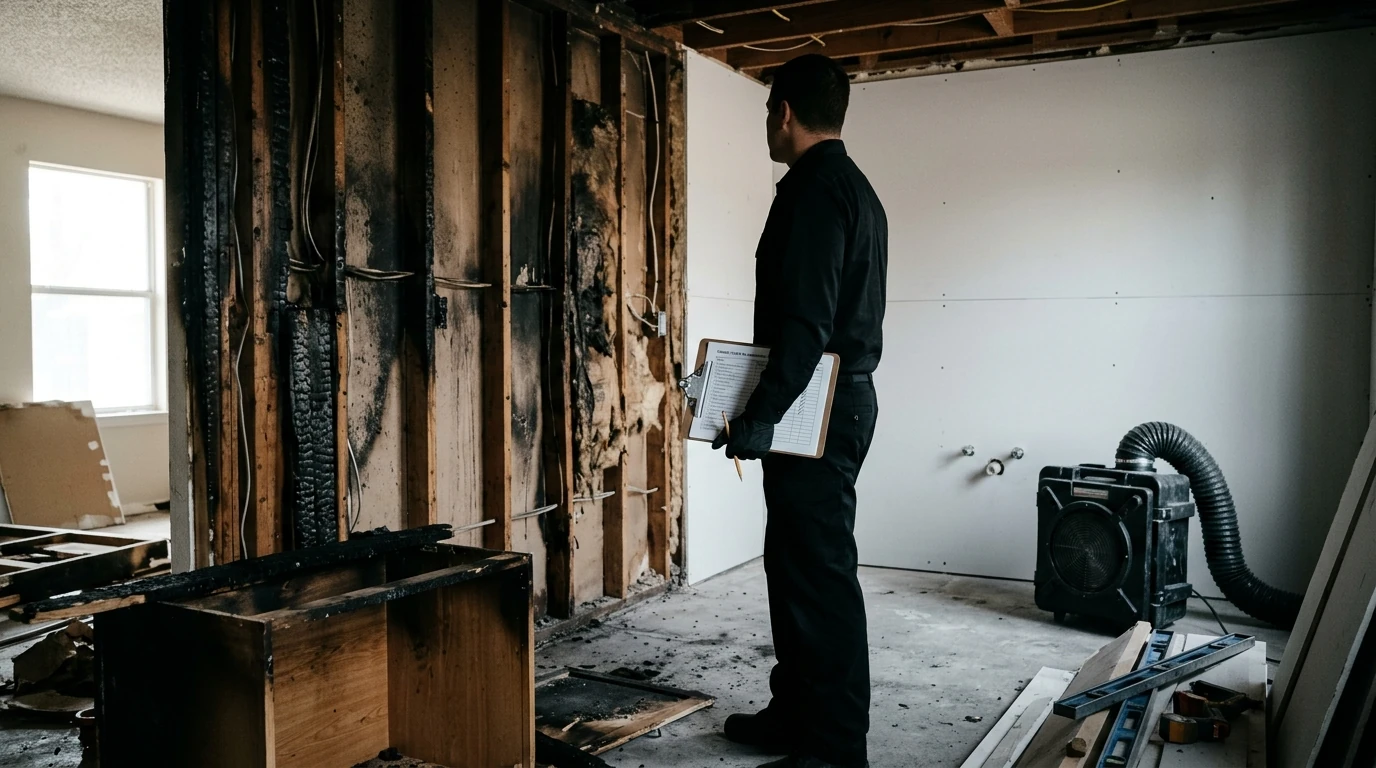
TL;DR: In Royse City, TX, the cost to rebuild a house after a fire ranges from roughly $2,500 for smoke and soot cleanup with no structural damage up to $200 to $400+ per square foot for a full gut-to-studs rebuild. The number depends almost entirely on how much of the home actually burned versus how much just absorbed smoke. Homeowners insurance usually pays toward the rebuild through dwelling coverage, plus separate money for temporary housing and damaged belongings, as long as the fire was sudden and accidental.
If a grease fire jumped from the stove to the cabinets, or a space heater took out part of a bedroom overnight, you’re probably holding an adjuster’s scope sheet right now and wondering if the number on it is even in the right neighborhood. Fire rebuild costs swing wildly because “fire damage” covers everything from a scorched cabinet to a collapsed roof. Here’s what actually drives the price in Royse City and the surrounding I-30 corridor, and what your policy is likely to cover.
How Much Does It Cost to Rebuild a House After a Fire in Royse City, TX?
Most fire-damaged homes in this area fall somewhere between $15,000 for a contained, single-room fire and $350,000 or more for a whole-house rebuild, with the final number set by square footage affected and how much structural framing, roofing, and electrical work has to be redone.
These are typical industry ranges, not a quote. Every fire is different, and a written scope from a licensed contractor is the only number you should actually budget against.
| Scenario | Typical Cost Range |
|---|---|
| Smoke and soot only, no flame contact | $2,500 to $10,000 |
| Contained kitchen fire (cabinets, counters, some drywall) | $15,000 to $50,000 |
| Single-room fire with structural framing damage | $40,000 to $90,000 |
| Multi-room fire with roof or attic involvement | $90,000 to $200,000 |
| Whole-house fire, gut to studs | $150,000 to $350,000+ |
| Total loss rebuild from the foundation up | $200 to $400+ per square foot |
What Actually Drives Fire Damage Repair Cost Up or Down?
The single biggest factor is how much square footage burned versus how much only took on smoke, because smoke-only rooms can usually be cleaned and repainted while fire-contact rooms often have to be torn out to the studs.
A handful of specifics do most of the work in any estimate:
- Structural framing. Charred studs, joists, or trusses have to be replaced, not just cleaned, and a structural engineer sometimes has to sign off before rebuild starts.
- Roof involvement. A fire that reaches the attic almost always means roof deck and possibly truss replacement, which is a different cost tier than drywall and paint.
- Electrical. Any wiring exposed to fire gets replaced, not tested and reused, because heat-damaged insulation is a safety issue the inspector will catch.
- Contents. Furniture, cabinetry, flooring, and personal belongings either get professionally cleaned and deodorized or replaced, and that line item adds up fast in a kitchen or living room fire.
- Code upgrades. If the home is older, the rebuild often has to meet current electrical and fire-safety code, even in rooms that weren’t touched by flame.
A contained kitchen fire is the most common version of this question we get. A grease fire that stays at the stove, scorches upper cabinets and the range hood, and smokes out the rest of the kitchen typically lands in the $15,000 to $50,000 range once cabinetry, countertops, some drywall, and smoke odor treatment are accounted for. A kitchen fire that burns through the wall cavity into an adjoining room or the attic moves into the next cost tier fast.
Partial Repair or Full Rebuild: How Do You Know Which One You Need?
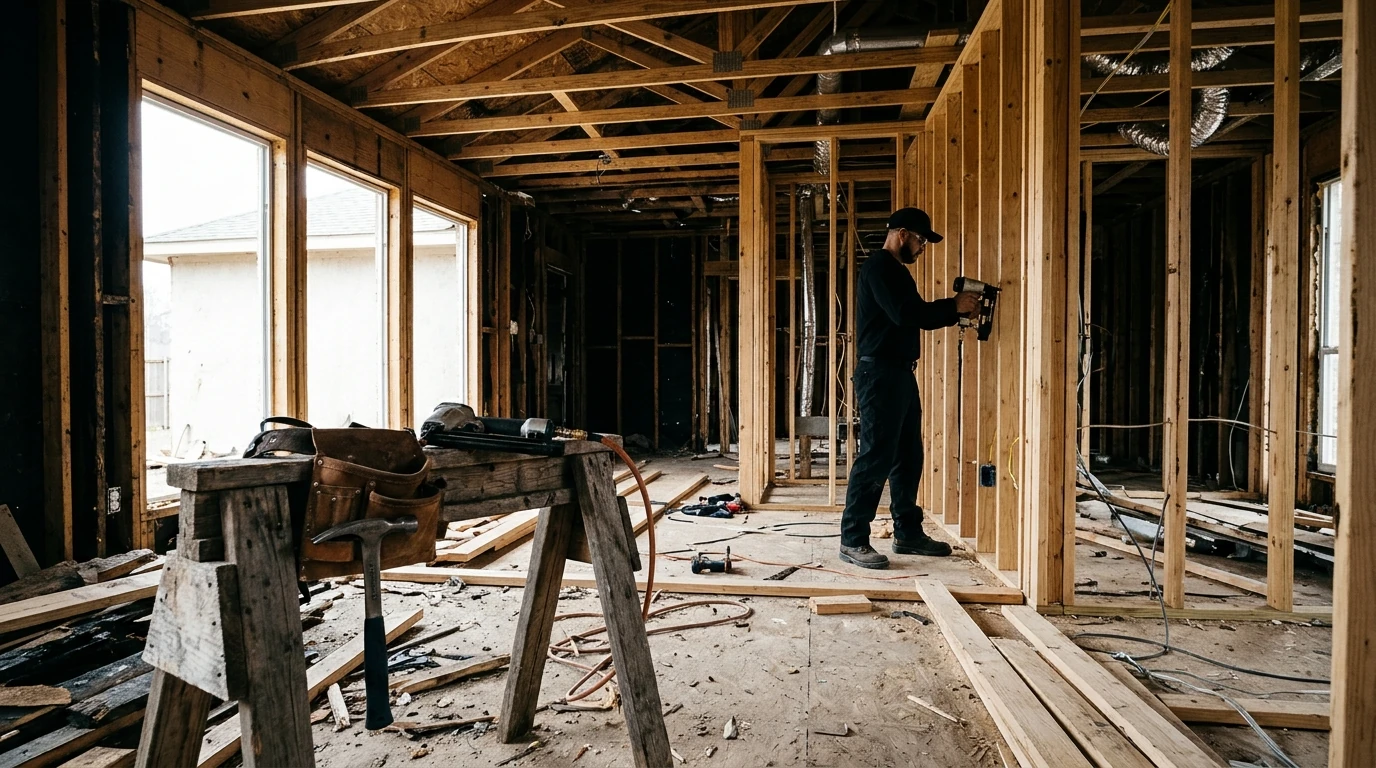
A home needs a full gut-to-studs rebuild when fire, heat, or firefighting water has compromised the structural framing in multiple rooms, not just one.
A partial repair makes sense when the damage stayed contained to one or two rooms and the framing underneath is still structurally sound once charred material is removed. The call isn’t a guess. It comes from a documented inspection: moisture readings on remaining framing, a visual and sometimes instrument check for char depth, and often a second opinion from a structural engineer on load-bearing members.
This is also where insurance language starts to matter. Adjusters and contractors sometimes disagree on where “repair” ends and “rebuild” begins, which is exactly why a written scope of work from the restoration contractor, not just the adjuster’s initial estimate, protects you if the job turns out to be bigger than it first looked.
What Does Homeowners Insurance Pay For in a Fire Rebuild?
A standard homeowners policy typically pays toward a fire rebuild through three separate pots of money: dwelling coverage for the structure, Additional Living Expenses (ALE) for temporary housing, and personal property coverage for damaged belongings, assuming the fire was sudden and accidental rather than caused by neglect (what is covered by a standard homeowners policy).
Dwelling coverage has a policy limit, and if the rebuild cost exceeds it, you’re responsible for the gap unless you carry extended replacement cost coverage. Ordinance or Law coverage, a separate add-on many homeowners don’t realize they have or don’t have, is what pays for the code upgrades mentioned above; without it, bringing an older home’s wiring or framing up to current code comes out of pocket. ALE covers a hotel or rental while the home is unlivable, but only for a defined period and dollar amount, so keep every receipt. Contents coverage usually requires a detailed, itemized list of damaged belongings, which is one reason professional contents restoration and inventory documentation matters before anything gets thrown away.
Homeowners also have a duty to mitigate further damage once the fire is out, boarding up openings and starting cleanup promptly protects the claim. Texas homeowners dealing with a denied or disputed claim can find consumer resources through the Texas Department of Insurance. For more on how an experienced general contractor handles the insurance side of a rebuild specifically, see how to choose the right rebuild partner for an insurance claim.
What Does the Rebuild Process and Timeline Actually Look Like?
A fire rebuild moves through mitigation, demolition, and reconstruction in that order, and the timeline runs anywhere from a few weeks for a contained room to 6 to 12 months for a whole-house rebuild.
- Emergency mitigation and board-up, usually within the first day, to secure the structure and stop further weather or water intrusion.
- Damage assessment and scope, documenting every affected area with photos and moisture or char readings, which becomes the basis for both the insurance claim and the contractor’s bid.
- Smoke, soot, and odor remediation, cleaning salvageable surfaces and running odor treatment, following the IICRC S700 standard for fire and smoke restoration.
- Demolition of unsalvageable drywall, flooring, cabinetry, and framing.
- Reconstruction, rebuilding to current code, including any electrical or structural upgrades required by the local building department.
- Contents restoration and final walkthrough, returning cleaned belongings and closing out the punch list with the homeowner and, often, the adjuster.
For a closer look at each phase, see the fire damage restoration process explained.
A fire doesn’t give you time to shop around while the adjuster is waiting on a scope. Reign Restoration handles the mitigation, the reconstruction, and the documentation an insurance claim needs under one roof, so the rebuild doesn’t stall between contractors.
About Reign Restoration
Reign Restoration is an IICRC Certified Firm (license MRC2276) serving Royse City, TX and the surrounding Rockwall and Dallas-area communities. The company’s technicians hold IICRC credentials in water, mold, and fire and smoke restoration (FSRT), and the team, led by Jerrott Gray, handles fire damage restoration, smoke damage restoration, reconstruction, and general contracting under one crew so a fire-damaged home doesn’t pass through multiple unconnected contractors during the rebuild.
Need help now? Call Reign Restoration at (214) 304-0621.